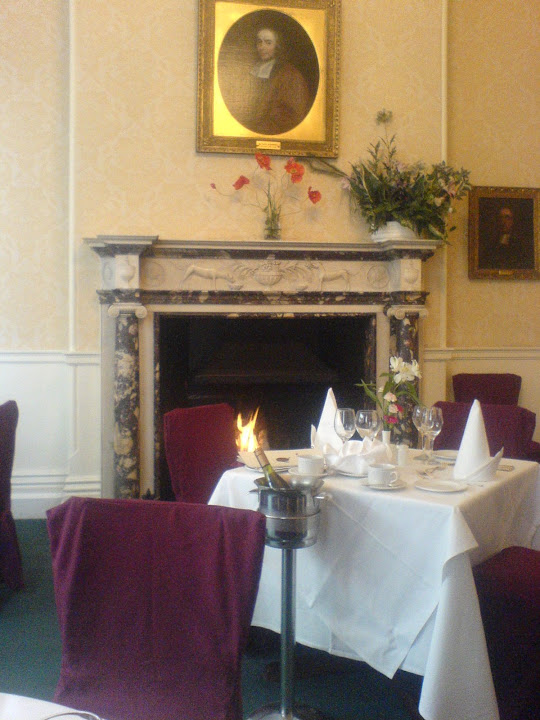
PS: it is amazing how many possiblities there are to serve coffee (and this is probably not one of the most environment friendly)
A blog on novel user interfaces, mobile applications, pervasive and ubiquitous computing. I use the blog as a note pad ;-)


PS: it is amazing how many possiblities there are to serve coffee (and this is probably not one of the most environment friendly)


I have been chairing the Stream "Aging as a Global Issue" at the conference Technologies of Globalization 2008 in Darmstadt. It is always very suprising who different research is across different diciplines...
On-Kwok Lai from Kwansei Gakuin University gave a really interesting overview on the current situation in Asia and in particular in Japan with regards the aging society. Learning more about ageing I find myself more often thinking the current “aging research” is more like treating a symptom and not looking at the real problem. And it seems the real problem: reduced reproduction in industrial states – basically we do not have enough children anymore. This leads to the obvious question: would researching into solutions and technologies that make it easier to raise children while working or studying not be the more important challenge?

In another talk Birgit Kasper reported from a study of multi-modal travel in Köln ("Patenticket"). In the trail they got people who have a yearly ticket to introduce other older people to public transport by providing them a 3 month flat-rate ticket for public transport in the region. The benefits seem to come from two sides: (1) people do not worry if they have the right ticket and (2) having a person that acts as a patron learning the public transport system is supported. If we look at the results a radical suggestion would be to introduce a car-city-tax (e.g. like London) and give in return free public transport to everyone – would this simple solution not solve many of our problems (economic, ecological, …) or would it create a two-tier society?

The social event was at castle Frankenstein – but surprisingly everyone came back in the morning unharmed ;-)


The last 2 day we had a meeting - with all faculty of the ICB - discussing the future challenges of work at universities in the context of our current situation. For me the this time was very well spent as I got to know many of my colleagues better and it was incredible to see the potential (from a scientific perspective as well as looking at the people) we have in our organization.
The current issue of the ct-Magazine (one of the largest computing magazines in Germany) features an introductory article on tangible user interfaces (in German).
Andreas Bulling presented work where he explored the use EOG goggles for context awareness and interaction. The EOG approach is complementary to video based systems. The use of gesturest for context-awarenes follows a similar idea as our work on eye gestures [3]. We had an interesting discussion about further ideas and perhaps there is chance in the future to directly compare the approaches and work together. 


We got a new USB GPS tracker(from Mobile Action, GT100) and had to try it out on the trip to Korea. It worked very well compared to the other devices we had so far. It got the bus trip in Düsseldorf airport right and the entire flight from Amsterdam to Seoul. Tracking worked well in the taxi from the Airport to the hotel. While walking in downtown Seoul it still performed OK (given the urban canyons) with some outliers.
On the way into town we got a really good price for the taxi (just make a mental note never to negotiate something with Florian and Alireza at the same time ;-) It seems taxi driving is sort of boring – he too watched television while driving (like the taxi driver some weeks ago in Amsterdam). I think we should seriously think more about entertainment for micro breaks because I still think it is for a good reason not allowed to watch TV while driving.
Seoul is an amazing place. There are many digital signs and electronic adverts. Walking back to the hotel I saw a large digital display on a rooftop (would guess about 10 meters by 6 meters). If working it is probably nice. But now it is mal functioning and the experience walking down the road is worsened as one inevitably looks at it. I wonder if in 10 years we will be used to broken large screen displays…
I have learned about Chumby an interesting platform that is designed to replace devices on your bedside table. Looking forward to get one or some when I fly next time to the US.
For a design competion at the appliance design conference I did a design concept for a networked alarm clock [1] assuming that networked device will be soon cheaply available. Maybe we should look at the paper again and think about how to push such ideas forward as the devices are on the market…
[1] Schmidt, A. 2006. Network alarm clock (The 3AD International Design Competition). Personal Ubiquitous Computing Journal. 10, 2-3 (Jan. 2006), 191-192. DOI= http://dx.doi.org/10.1007/s00779-005-0022-y
Imagine there is a song – you know band and title – and you want to buy it. Should not be really something worthwhile reporting in a blog…
How long does it take to buy a song and how many steps does it need? I tried myself and was pretty much amazed that it is still more difficult than other ways to get music. The idea was to put the song into my shopping cart, press check-out, pay by credit card, and download. On the stores I encountered you have to register before to buy… I finally got the song and here are the steps at a major German music store: go to shop page, search for song, put in shopping cart, go to checkout, told to register, fill in registration form, told to confirm email, opened email client, waited 3 minutes for email, confirmed email, logged in on webpage, realized shopping card is empty :-(, search for song, put in shopping cart, go to checkout, entered credit card information, pay about 1.69€, got download link, got music.
I really wonder how many people will become first time buyers in this shop. Sometimes I think the things we teach in User Interface Engineering are obvious – but real life tells me they are not! If you run a music download portal or if you are in the music business and you wonder why no-one buys – we can tell you :-) it may be about utility and usability of your online offers… if you need more details we are happy to help you :-)
PS: there was a store with a .ru address with better usability that offered the song with no registration at 0.20€ - but I did not want to give my credit card details…
Yesterday there was a workshop on Mobile and Embedded Interaction as part of Informatik2008 in Munich. The talks and discussions were very interesting. Lucia and Thomas raised interesting issues on a new notion of personal computing, where the mobile device becomes the center of a personal computing infrastructure. This idea has been around for some time (e.g. Roy Wants Personal Server [1]) but the new ideas and the feasibility with current hardware makes it really an exciting topic. On the general topic there are many open questions, as visible on the slide.

After the workshop, when swapping business cards, we started the discussion when in the future we will have business cards (in larger quantities, to give away) that have active display elements (e.g. eInk) included. Everyone gave a predictions in how many years we will have it (Lucia Terrenghi:never; Raimund Dachselt:7; Thomas Lang: business card will disappear; Albrecht Schmidt:9; Heiko Drewes:10; Florian Echtler:5; Michael Rohs:5; Paul Holleis:5). Lets get back in 5 years and see… In September 2008 the Esquire Magazine featured an e-ink cover page - have not seen it myself:-( but there is a video: http://www.esquire.com/the-side/video/e-ink-cover-video
Today we organized a workshop on Software, Services and Platforms for new infrastructures in telecommunication. We had a set of really interesting talks. As I did my PhD on context-awareness I was quite impressed by work on context oriented programming and the advances over the last years in this domain (good starting point on the topic with some publications [2]).
At the end of the workshop I gave the following scenario as an impulse for discussion: image there are 10 million facebook users that contniouly stream the video of what they see into the net, e.g. using eagle-i. The discussion raise many technical as well as social challenges!
[1] Want, R., Pering, T., Danneels, G., Kumar, M., Sundar, M., and Light, J. 2002. The Personal Server: Changing the Way We Think about Ubiquitous Computing. In Proceedings of the 4th international Conference on Ubiquitous Computing (Göteborg, Sweden, September 29 - October 01, 2002). G. Borriello and L. E. Holmquist, Eds. Lecture Notes In Computer Science, vol. 2498. Springer-Verlag, London, 194-209.
[2] http://www.swa.hpi.uni-potsdam.de/cop/
PS: there are few photos as someone in the workshop today objected to be on the net…
For the second time we ran this year a workshop on automobile user interfaces and interactive applications in the car at the German HCI conference: http://automotive.ubisys.org/

In the first session we discussed the use of tactile output and haptics in automotive user interfaces. It appears that there is significant interest in this area at the moment. In particular using haptics as an additional modality creates a lot of opportunities for new interfaces. We had a short discussion about two directions in haptic output: naturalistic haptic output (e.g. line assist that feels like going over the side of the road) vs. generic haptic output (e.g. giving a vibration cue when to turn).

I think the first domain could make an interesting project – how does it naturally feel to drive too fast, to turn the wrong way, to be too close to the car in front of you, etc…
In a further session we discussed framework and concepts for in-car user interfaces. The discussion on the use of context with the interface was very diverse. Some people argued it should be only used in non-critical/optional parts of the UI (e.g. entertainment) as one is not 100% sure if the recognized context is right. Others argue that context may provide a central advantage, especially in safety critical systems, as it gives the opportunity to react faster.

In the end it comes always down to the question: to what extent do we want to have the human in the loop… But looking at Wolfgang's overview slide it is impressive how much functionality depends already now on context...
In the third session we discussed tools and methods for developing and evaluating user interfaces in the car context. Dagmar presented our first version of CARS (a simple driving simulator for evaluation of UIs) and discussed findings from initial studies [1]. The simulator is based on the JMonkey Game engine and available open source on our website [2].
There were several interesting ideas on what topics are really hot in automotive UIs, ranging from interfaces for information gather in Car-2-Car / Car-2-Envrionment communication to micro-entertainment while driving.
[1] Dagmar Kern, Marco Müller, Stefan Schneegaß, Lukasz Wolejko-Wolejszo, Albrecht Schmidt. CARS – Configurable Automotive Research Simulator. Automotive User Interfaces and Interactive Applications – AUIIA 08. Workshop at Mensch und Computer 2008 Lübeck 2008
[2] https://www.pcuie.uni-due.de/projectwiki/index.php/CARS

PS: In a taxi in Amsterdam the driver had a DVD running while driving – and I am sure this is not a form of entertainment that works well (it is neither fun to watch, nor is it save or legal).

Last winter term I was teaching a class on Unconventional User Interfaces at the University of Linz as part of the MSc in Pervasive Computing. As part of the exercises the students had to do a project and write a paper on the topic in a group. This required to do a full round in the development (from idea creation to study).
Florian König and his group had an exciting idea for a novel form of advertisement. The user is mirrored in the advert and becomes a part of it. They implemented an interactive poster for a travel agent (users become part of the holyday scene) and tested it in-situ. The paper was accepted at the German HCI conference (Mensch und Computer) and Florian presented it today very well [1].

In the questions there was much discussion about privacy and user acceptance. We discussed whether or not such a installation would be legal in Germany (people mentioned the Datenschutzgesetz §6).
[1] Johannes Schönböck, Florian König, Gabriele Kotsis, Dominik Gruber, Emre Zaim, Albrecht Schmidt. MirrorBoard – An Interactive Billboard. Mensch und Computer 2008. Lübeck. Oldenbourg Verlag, 2008, p 207-216.