Thursday, 1 December 2011
Bryan Reimer: Opening keynote at Auto-UI 2011 in Salzburg
The central question he raised is: how to create user interface that fit human users? He made an important point: humans are not “designed” to drive at high speed in complex environments; perception has evolved for walking and running in natural environment. Additionally to the basic limitations of human cognition, there is a great variety of capabilities of drivers, their skills and cognitive ability (e.g. influence of age). A implication of the global change is demographics is that the average capabilities of a drivers will be reduced – basically as many older people will be drivers…
Over the last 100 years cars have changes significantly! Looking more closely Bryan argues that much of the chance happened in the last 10 years. There has been little change from the 1950s to the 1990s with regard to the car user interface.
It is apparent that secondary tasks are becoming more important to the user. Users will interact more while driving because the can. It is however not obvious that they are capable of it.
Even given these developments it is apparent that driving has become safer. Passive safety has been improved massively and this made driving much safer. There seems to be a drawback to this as well, as people may take greater risks as they feel safer. The next step is really to avoid accidence in the first place. Bryan argues that the interaction between driver, environment, and vehicles is very important in that. He suggests that we should make more of an effort to create systems that fit the drivers.
The Yerkes-Dodson Law helps to understand how to design systems that keep peoples attention in the optimal performance. He made an important point: there are certain issues that cannot be solved, e.g. if someone is tired we can do only very little – the driver will need to rest. We should make sure that we take these things into account when designing systems.
Visual distraction is an obvious factor and much discussed in the papers at the conference – but Bryan argued that “eyes on the road” is not equal to “mind on the road”. I think this is really a very important point. Ensuring that people keep their eyes on the road, seeing things is not enough. The big resulting question is how to keep or get people focused on the street and environment. It seems there is some more research to do…
The variety of interfaces and interaction metaphors build into cars opens more choices but at the same time creates problems, as people need to learn and understand them. A simple question such as: How do you switch the car off? may be hard to answer (Bryan had the example of a car with a push button starter, where you cannot remove the key). I think there are simple questions that can be learned from industry and production machines… add an emergency stop button and make it mandatory ;-)
If you are interested more about Bryan’s work look at his webpage or his page at the MIT agelab or one of his recent publications [1] in the IEEE Pervasive Computing Magazine’s special issue on automotive computing, see [2] for an introduction to the special issue.
Sorry for the poor quality photos ... back row and an iPhone...
[1] Joseph F. Coughlin, Bryan Reimer, and Bruce Mehler. 2011. Monitoring, Managing, and Motivating Driver Safety and Well-Being. IEEE Pervasive Computing 10, 3 (July 2011), 14-21. DOI=10.1109/MPRV.2011.54 http://dx.doi.org/10.1109/MPRV.2011.54
[2] Albrecht Schmidt, Joseph Paradiso, and Brian Noble. 2011. Automotive Pervasive Computing. IEEE Pervasive Computing 10, 3 (July 2011), 12-13. DOI=10.1109/MPRV.2011.45 http://dx.doi.org/10.1109/MPRV.2011.45
Friday, 30 July 2010
Call for Papers: IEEE Pervasive Computing special Issue on Automotive Pervasive Computing
Cars have become an interesting and challenging microcosm for pervasive computing research and we invite articles relating to pervasive computing in the automotive context. Examples of relevant topics are:
- Pervasive sensor systems in the car
- Use of sensors and context for automotive applications
- Contextual vehicular applications
- Collaborative sensing with multiple cars
- Concepts for in-car user interfaces based on pervasive computing techology
- Multi-modal interaction in the car
- Detecting user intentions, emotions, and distraction
- User interfaces for assistive functionality and autonomous driving
- Applications of car to car communication
- Contextual information and navigation systems
- Technologies to improve media consumption while driving
- Communication appliances for drivers and passengers
- In-car pervasive gaming for passengers and drivers
- Experiences with pervasive computing technologies in cars
- Case studies of automotive pervasive computing
- Ethnographic work on the use of technologies in cars
For details see the cfp at: http://computer.org/pervasive/cfp3
Saturday, 8 August 2009
update on e-cars

I think I like the Tesla Roadster ;-)
Friday, 31 July 2009
Auto-UI 2009 and TEI2010 - deadlines not to miss -
This year the deadline for submitting papers to TEI 2010 is much earlier than in previous years! It is the 10th of August (and was already extended)…
Wednesday, 29 July 2009
New Power Plug in the Street - charging your e-car
Why would I write a post about a power plug? Perhaps in some years this may be so common that we do not know when the first appeared ;-) And here is my reference point for Essen, Germany.There is a German news article about these chargeing points - there are 22 in Essen and they started sometime back in Berlin (where they plan to have 500 by the end of the year).
It looks very much like an ordinary power plug and I have not figured out how it really works - e.g. How to pay? How to reserve that parking in front of it? How to make sure that nobody unplugs may car and used my energy to drive a huge stereo? We will probably see how it works over the next months. I will add a new post when I actually see a car recharging there.new post on the topic:
http://albrecht-schmidt.blogspot.com/2009/08/update-on-e-cars.html
Tuesday, 28 July 2009
What do people like about navigation system?
I came across this study in computer bild - you should not cite it as it in a scientific paper as "computer bild" - is consumer paper telling people mainly which computers to buy and how to use obvious features in software ;-)Nevertheless it is interesting and gave me some ideas what navigations systems are good for and it is another example that user needs on an abstract level (e.g. as in Maslows hierarchy of needs) could be interesting to inform designs.
If you do not read German here are the results in short:
- 91% faster to their destination
- 88% less often being lost
- 88% feel saver when driving with a SatNav
- 67% less often in traffic jams
- 57% driving is more fun
- 54% argue less in the car because of SatNav
Wednesday, 13 May 2009
Our Publications at Pervasive - Public Displays, Car Adverts, and Tactile Output for Navigation
Our group was involved in 3 papers that are published at Pervasive 2009 in Nara.The first contribution is a study on public display that was presented by Jörg Müller from Münster. The paper explores display blindness that can be observed in the real world (similarly to banner blindness) and concludes that the extent to which people look at displays is very much correlated to the users expectation of the content of a display in a certain location [1].
The second short paper is a survey on car advertising and has been conducted in the context of the master thesis of Christoph Evers. The central question is about the design space of dynamic advertising on cars and how the users perceive such a technology [2].
Dagmar presented a paper on vibra-tactile output integrated in the steering wheel for navigation systems in cars. The studies explored how multi-modal presentation of information impact driving performance and what modalities are preferred by users. The general conclusion is that combining visual information with vibra-tactile output is the best option and that people prefer multi-modal output over a single modality [3].[1] Jörg Müller, Dennis Wilmsmann, Juliane Exeler, Markus Buzeck, Albrecht Schmidt, Tim Jay, Antonio Krüger. Display Blindness: The Effect of Expectations on Attention towards Digital Signage. 7th International Conference on Pervasive Computing 2009. Nara, Japan. Springer LNCS 5538, pp 1-8.
http://www.springerlink.com/content/gk307213786207g2
[2] Florian Alt, Christoph Evers, Albrecht Schmidt. User's view on Context-Aware Car Advertisement. 7th International Conference on Pervasive Computing 2009. Nara, Japan. Springer LNCS 5538, pp 9-16.
http://www.springerlink.com/content/81q8818683315523
[3] Dagmar Kern, Paul Marshall, Eva Hornecker, Yvonne Rogers, Albrecht Schmidt. Enhancing Navigation Information with tactile Output Embedded into the Steering Wheel. 7th International Conference on Pervasive Computing 2009. Nara, Japan. Springer LNCS 5538, pp 42-58.
http://www.springerlink.com/content/x13j7547p8303113
Friday, 19 September 2008
Which way did you fly to Korea?
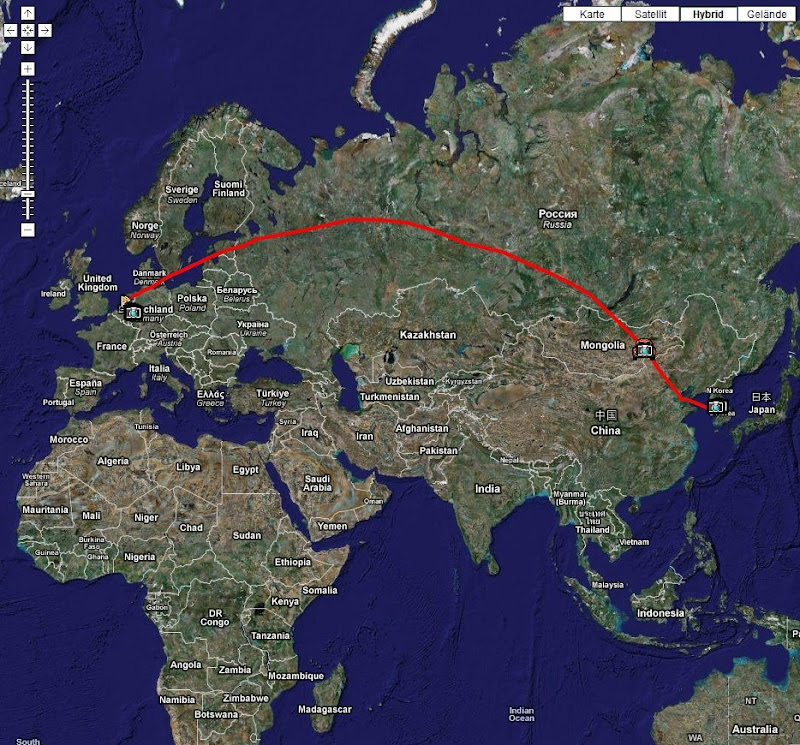
We got a new USB GPS tracker(from Mobile Action, GT100) and had to try it out on the trip to Korea. It worked very well compared to the other devices we had so far. It got the bus trip in Düsseldorf airport right and the entire flight from Amsterdam to Seoul. Tracking worked well in the taxi from the Airport to the hotel. While walking in downtown Seoul it still performed OK (given the urban canyons) with some outliers.
Back in Korea, Adverts, Driving and Entertainment
On the way into town we got a really good price for the taxi (just make a mental note never to negotiate something with Florian and Alireza at the same time ;-) It seems taxi driving is sort of boring – he too watched television while driving (like the taxi driver some weeks ago in Amsterdam). I think we should seriously think more about entertainment for micro breaks because I still think it is for a good reason not allowed to watch TV while driving.
Seoul is an amazing place. There are many digital signs and electronic adverts. Walking back to the hotel I saw a large digital display on a rooftop (would guess about 10 meters by 6 meters). If working it is probably nice. But now it is mal functioning and the experience walking down the road is worsened as one inevitably looks at it. I wonder if in 10 years we will be used to broken large screen displays…
Wednesday, 16 July 2008
GPS monitoring for car insurance
references, here they are…
My example was based on the pilot announced from the German insurance WGV. They planned to run a pilot with 1500 people using a GPS based monitoring devices. The box is mounted in the car and compares the current speed with the allowed speed limit and warns to reduce speed (if over the limit). If the driver is more than 12 times per year over the speed limit (basically ignoring the warning) he does not get the reduced rate. (see http://www.wgv-online.de/docs/youngandsafe.pdf - in German only). In the announcement it said they will run the pilot to 2009...
There are different ideas how to take GPS driving monitoring beyond the lab, e.g. in 2007 Royal & SunAlliance announced a GPS-based eco car insurance and the AIG a Teen GPS Program – targeted at parents.
Looking at different comments (on news pages and in blogs) it seems that people's opinions are very split...
Thursday, 3 July 2008
Innovative in-car systems, Taking photos while driving
Wolfgang just sent me another picture (taken by a colleague of him) with more information in the head-up display. It shows a speed of 180 km/h and I wonder who took the picture. Usually only the driver can see such a display ;-)For assistance, information and entertainment systems in cars (an I assume we could consider taking photos an entertainment task) there are guidelines [1, 2, 3] - an overview presentation in German can be found in [4]. Students in the Pervasive Computing class have to look at them and design a new information/assistance system that is context aware - perhaps photography in the car could be a theme... I am already curious about the results of the exercise.
[1] The European Statement of Principles (ESoP) on Human Machine Interface in Automotive Systems
[2] AAM Guidelines
[3] JAMA Japanese Guidelines
[4] Andreas Weimper, Harman International Industries, Neue EU Regelungen für Safety und Driver Distraction
(thanks to Wolfgang Spießl for sending the references to me)
Wednesday, 2 July 2008
Wolfgang Spießl introduces context-aware car systems
In his lecture he showed many examples how pervasive computing happens in the car already now. After the talk we had the chance see and discuss user interface elements in current cars – in particular the head up display. Wolfgang gave demonstration of the CAN bus signals related to interaction with the car that are available to create context-aware applications. The car head-up display (which appears as being just in front of the car) create discussions on interesting use cases for these types of displays - beyond navigation and essential driving information.
In the lecture questions about how feasible / easy it is to do your own developments using the UI elements in the car – basically how I can run my applications in the car. This is not yet really supported ;-) However I had a previous post [2] where I argue that this is probably to come… and I still see this trend... It may be an interesting though how one can provide third parties access to UI components in the car without giving away control...[1] Albrecht Schmidt. Ubiquitous Computing - Computing in Context. PhD Thesis, November 2002. http://www.comp.lancs.ac.uk/~albrecht/phd/
[2] Albrecht Schmidt. Will cars become a more open platform?
Thursday, 10 April 2008
Wolfgang Spießl presented our CHI-Note
[1] Graf, S., Spiessl, W., Schmidt, A., Winter, A., and Rigoll, G. 2008. In-car interaction using search-based user interfaces. In Proceeding of the Twenty-Sixth Annual SIGCHI Conference on Human Factors in Computing Systems (Florence, Italy, April 05 - 10, 2008). CHI '08. ACM, New York, NY, 1685-1688. DOI= http://doi.acm.org/10.1145/1357054.1357317
[2] Leshed, G., Velden, T., Rieger, O., Kot, B., and Sengers, P. 2008. In-car gps navigation: engagement with and disengagement from the environment. In Proceeding of the Twenty-Sixth Annual SIGCHI Conference on Human Factors in Computing Systems (Florence, Italy, April 05 - 10, 2008). CHI '08. ACM, New York, NY, 1675-1684. DOI= http://doi.acm.org/10.1145/1357054.1357316
Thursday, 31 January 2008
Will cars become a more open platform?
It is really curious to see that there is a lot of interest in the hobbyist communities on car interfaces and protocols. In the June/2007 issues of Elektor (http://www.elektor.de/) was an article on a OBD-2-analyser, in a recent issue of the EAM (http://www.eam-magazin.de/) was a similar article and there are many community sites on the WWW, e.g. http://www.canhack.de/
Perhaps we could do in one of our pervasive computing related classes a project on this topic? There are so many technical opportunities and the challenge is to find the convincing applications!
Thursday, 6 December 2007
Talk at the expert meeting on RFID and ubicomp
In Frankfurt there was today an expert meeting on RFID and ubicomp organized by the Fraunhofer ISI. The purpose was a discussion about the impact of RFID technologies. The organizers will use our input to inform the creation of a document of technology assessment for the German parliament. The majority of the participants came from companies developing RFID technology or system.In the first part of my talk “RFID and Beyond” I highlighted results from two workshops where I was a co-organizer: PTA2006 and Pertec2007 held at the Pervasive and Percom conferences. The results were also published in 2 papers in the IEEE Pervasive Computing magazine, see [1] and [2]. After this I showed some future visions and scenarios, namely the Smart-Its & MediaCup (foto from Birgit at Teco) [3], the SensorKnife [4], and the aware goods project [5]. Michael Müller extended the idea of the first aware goods project with a mobile phone based prototype - which we still have not written up for publication.
For me the technology assessment in Germany seems still often very much centred on threats and looks much less at opportunities. Looking at developments in Asia and in particular in Korea (e.g. U-City) I hope politics in Germany will in the future more often see the positive sides, too. Technology assessment can become a means to find opportunities and ideas to support innovation. For me it seems that a lot of the risks people attribute to RFID are not based on scientific results – is appears rather media induced… Positive cases such as wireless key systems and transport tickets (basically RFID technology) are in widespread use without much problems and great value for users - but not present in the public discussion.
One interesting estimated was that about 200 parts of the several thousands (e.g. safety related parts, large parts, parts that are often stolen, expensive parts) per car will tagged with RFID in the next 10 years to ease logistics, production and maintenance.
[1] Schmidt, A.; Spiekermann, S.; Gershman, A.; Michahelles, F., "Real-World Challenges of Pervasive Computing", Pervasive Computing, IEEE , vol.5, no.3pp. 91- 93, c3, July-Sept. 2006.
[2] Michahelles, F.; Thiesse, F.; Schmidt, A.; Williams, J. R.: Pervasive RFID and Near Field Communication Technology. In: IEEE Pervasive Computing, vol. 6, no. 3, pp. 94-96, c3, Jul., 2007.
[3] Hans-Werner Gellersen, Albrecht Schmidt, Michael Beigl: Multi-Sensor Context-Awareness in Mobile Devices and Smart Artifacts. MONET 7(5): 341-351 (2002)
[4] Matthias Kranz, Albrecht Schmidt, Alexis Maldonado, Radu Bogdan Rusu, Michael Beetz, Benedikt Hörnler, Gerhard Rigoll: Context-aware kitchen utilities. Tangible and Embedded Interaction 2007: 213-214
[5] Anke Thede, Albrecht Schmidt, Christian Merz: Integration of Goods Delivery Supervision into E-commerce Supply Chain. WELCOM 2001: 206-218
Monday, 17 September 2007
Car UIs transport Emotion
It is often discussed whether or not the user interface in the car matters or not. The basic argument is that cars are emotional and hence the driving experience matters and everything else is secondary.However it seems the user interface becomes more and more part of the experience. On Saturday night I travelled via
The opening keynote at Ubicomp was given by Antonio Calvosa from Ferrari. Here two a very experienced and user interface focus could be seen. The talk touched issues of emotion and affective issues. Overall he argues that Ubicomp technologies should amplify what humans like to perceive.
Tuesday, 4 September 2007
Automotive User Interface Workshop
At the German HCI conference (Mensch und Computer) I organized together with Paul Holleis and Klaus Bengler (BMW Group) a workshop on automotive user interfaces. We were surprised how many people work and research in this area in Germany and Austria.The 9 talks showed a wide range of research results and questions ranging from activity recognition, search interfaces, cultural issues to research methods. Dagmar Kern presented our work on a new method for interviewing drivers at the gas station. Stefan Graf from BMW groups had an interesting demo on object oriented interaction and in-car text input.
In the final session we discussed on future challenges of automotive user interfaces and it seems that it is a great challenge as cars are very emotional products. One interesting point was that user interfaces may not be central for the decisions which car to buy - but if not satisfied it will influence the decisions not to buy such a car again.Context and context-awareness (e.g. based on user activity, driving parameters and location) seems to provide a great opportunity for future interfaces and in-car applications. One nice example was presented by Susanne Boll from a joint project with VW (C3World, connected cars in a connected world).
Wednesday, 29 August 2007
What do you decide in the car?
KIA has done a survey (with over 2000 people) in the UK on decision making in the car. It appears that people use the time in the car to discuss major issues in their lives and that they make significant decisions during long journeys. I have not found the original survey from KIA but there are several pages that discuss the results, e.g. gizmag.
Some findings in short, people talked about/made descions: going on holiday (63%), buying a car (50%), moving (40%), getting a pet (26%), getting married (23%). The main reason for the car on a long journey being an effective environment for communication seems the fact the people are close together for a long time and no-one can walk away (41%). Also the fact that you have reason not to look the other person into the eyes, as you have to watch the street, was valued.
Thinking about it there it may also have to do with the function of space. A car puts people close together – in some case to intimate distances (up to 50cm) but defiantly to personal distances (50cm-125cm). There is a comprehensive overview by Nicolas Nova, Socio-cognitive functions of space in collaborative settings: a literature review about Space, Cognition and Collaboration (original reference to my knowledge is Hall, E.T. (1966). The Hidden Dimension: Man’s Use of Space in Public and Private. Garden City, N.Y.: Doubleday.).
This survey made me think more about the design space "car". Recently two of my students - Anneke Winter and Wolfgang Spießl - finished there master projects at BMW looking into search technologies and user interfaces in the car. It seems there are a lot of ideas that can be pushed forward realizing Ubicomp in the car.