Florian Michahelles mentioned in his blog a talk [1] and paper [2] by Aaron Beach on mobile social networks that are linked to artefacts (e.g. clothing) in the real world. This is really interesting and I think we should look more into this...
[1] Aaron Beach. University of Colorado. Whozthat: Mobile Social Networks. Whoz touching me? Whoz Music? Whoz Watching? Who Cares?
[2] Beach, A.; Gartrell, M.; Akkala, S.; Elston, J.; Kelley, J.; Nishimoto, K.; Ray, B.; Razgulin, S.; Sundaresan, K.; Surendar, B.; Terada, M.; Han, R., "WhozThat? evolving an ecosystem for context-aware mobile social networks" Network, IEEE , vol.22, no.4, pp.50-55, July-Aug2008
Tuesday, 4 August 2009


Sunday, 2 August 2009
Maps - still the tool for navigation in the mountains
 On Saturday we went to Garmisch and walked up to Höllentalklamm (a nice canyon) and had lunch at Höllentalangerhütter. Our GPS tracking data from the canyon was pretty poor (as one would expect as the canyon is in parts only a few meters wide).
Observing other hikers (especially people who did the larger tours) it was very interesting to see how maps are used in social situations - planning, discussion, reflection, and storytelling (this time n>10). It is hard to image how this experience can be replaced by an implementation on a mobile device.
 Will we have to wait till we have 1 meter by 1 meter foldable e-ink displays with 200dpi? Or are there other means to implement a good hiking map on a mobile phone screen? There is a lot of ongoing research in this domain. For driving I would guess the paper map has been largely replaced by electronic devices - when will it happened for hiking?
 My guess is that traditional hiking maps will be the standard tool for another 10 years - obviously combined with a mobile device with GPS (e.g. phone, watch, or specific hiking GPS). There many ideas on how to do this - Johannes Schöning and Michael Rohs have worked on that for a while. The WIP they hat at CHI is an interesting example [1] or see the video on youtube.
Projector phones are a hot topic - Enrico had some interesting work on interaction with projector phones at Mobile HCI 2008 [2] & [3]. I would expect that in a years time we will see quite a number of those devices on the market.
[1] Schöning, J., Rohs, M., Kratz, S., Löchtefeld, M., and Krüger, A. 2009. Map torchlight: a mobile augmented reality camera projector unit. In Proceedings of the 27th international Conference Extended Abstracts on Human Factors in Computing Systems (Boston, MA, USA, April 04 - 09, 2009). CHI EA '09. ACM, New York, NY, 3841-3846. DOI= http://doi.acm.org/10.1145/1520340.1520581
[2] Hang, A., Rukzio, E., and Greaves, A. 2008. Projector phone: a study of using mobile phones with integrated projector for interaction with maps. In Proceedings of the 10th international Conference on Human Computer interaction with Mobile Devices and Services (Amsterdam, The Netherlands, September 02 - 05, 2008). MobileHCI '08. ACM, New York, NY, 207-216. DOI= http://doi.acm.org/10.1145/1409240.1409263
[3] Greaves, A. and Rukzio, E. 2008. Evaluation of picture browsing using a projector phone. In Proceedings of the 10th international Conference on Human Computer interaction with Mobile Devices and Services (Amsterdam, The Netherlands, September 02 - 05, 2008). MobileHCI '08. ACM, New York, NY, 351-354. DOI= http://doi.acm.org/10.1145/1409240.1409286
Friday, 31 July 2009
Summer party at the chair of ergonomics in Munich
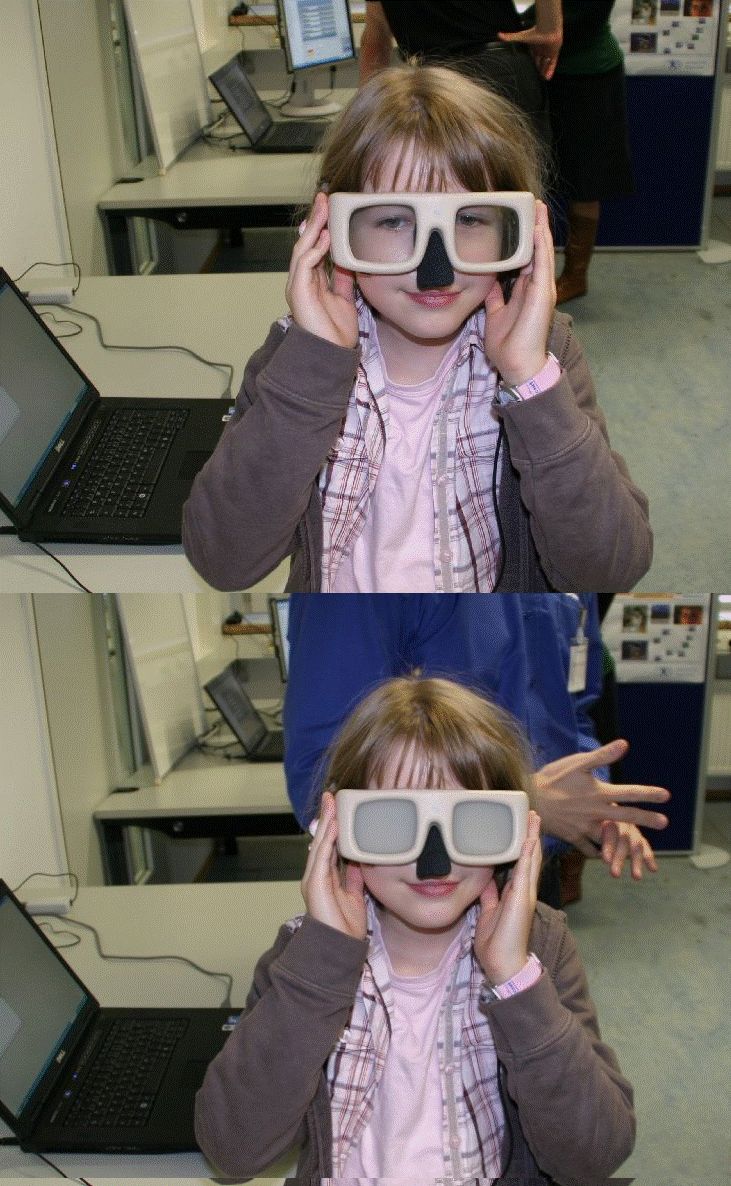 On Friday afternoon I was at the summer party of the chair of ergonomics at the Technical University of Munich. Klaus Bengler, who took over the chair earlier this year and became professor, had in his talk 3 interesting points to take away:
- to assess more how much does bad ergonomics costs us (from health to missed sales)
- to quantify the value of ergonomics in real money in order to make it comparable with other factors in product design
- to include ergonomics as an integral part of the development process
 From my Computer Science/HCI perspective I think (2) would be top of the list - as we have good approaches to (3) but need (2) to push it and as (1) is part of (2)… It would be great to have an argument based on economics. E.g. adding tactile feedback will costs x € and it will increase the value of the product by y € - if x>y do it - else don't … still no idea how one would do this - but would be great if possible!
 The researchers and students had prepared a large number of demos - mainly centered on ergonomics in the car, sports ergonomics, and mobile eye-tracking. Hard to pick a favorite but I liked the joystick control for steering a car a lot (there will be a paper on this at the automotive UI conference).
Print on demand for newspapers available at Munich central station.
 It is about 15 years that I came across the idea of newspapers - printed in the shop where you buy them (sometime when I studied in Ulm). Today I have seen an advert for print on demand newspapers in the international newspapers kiosk in the central station in Munich. They have 850 titles from 70 countries available - as print on demand. The display copies had a decent quality - looked like A3 size color laser printouts - perhaps I can fetch a copy tomorrow.
 I wonder how long it will take to move more (low volume papers, local supplements, etc.) to print on demand and how in the short term the split between e-ink and print on demand will be.
It was great to see in Munich so many people I previouly worked with!
Auto-UI 2009 and TEI2010 - deadlines not to miss -
Next week is the early registration deadline for the 1st International Conference on Automotive User Interfaces and Interactive Vehicular Applications (AutomotiveUI 2009) and the poster call is still open.
This year the deadline for submitting papers to TEI 2010 is much earlier than in previous years! It is the 10th of August (and was already extended)…
This year the deadline for submitting papers to TEI 2010 is much earlier than in previous years! It is the 10th of August (and was already extended)…
Thursday, 30 July 2009
Reto Wetach visits our lab... and looking for someone with expertise in pain
 Reto Wettach was in Essen so we took the opportunity to get together to flash out some ideas for a proposal - it is related to pain - in a positive sense. There is interesting and scary previous work, see [1] & [2]. For the proposal we still look for someone not from the UK and not from Germany - who has an expertise and interest in medical devices (sensors and actuators) and someone who has experience in pain and perception of pain (e.g. from the medical domain). Please let me know if you know someone who may fit the profile …
Before really getting to this we had a good discussion on the usefulness of the concept of tangible interaction - obviously we see the advantages clearly - but nevertheless it seem in many ways hard to proof. The argument for tangible UIs as manipulators and controls is very clear and can be shown but looking at tangible objects as carriers for data it becomes more difficult. Looking a physical money the tangible features are clear and one can argue for the benefit of tangible qualities (e.g. I like Reto's statement "the current crisis would not have happened if people would have had to move money physically") - but also the limitations are there and modern world with only tangible money would be unimaginable.
Taking the example of money (coins and bills) two requirements for tangible objects that embody information become clear:
- The semantic of the information carried by the object has to be universally accepted
- Means for processing (e.g. reading) the tangible objects have to be ubiquitously available
[1] http://www.painstation.de/
[2] Dermot McGrath. No Pain, No Game. Wired Magazin 07/2002.
[3] Shin'ichi Konomi, Christian Müller-Tomfelde, Norbert A. Streitz: Passage: Physical Transportation of Digital Information in Cooperative Buildings. Cooperative Buildings. Integrating Information, Organizations and Architecture. CoBuild 1999. Springer LNCS 1670. pp. 45-54.
Wednesday, 29 July 2009
New Power Plug in the Street - charging your e-car
 Why would I write a post about a power plug? Perhaps in some years this may be so common that we do not know when the first appeared ;-) And here is my reference point for Essen, Germany.
There is a German news article about these chargeing points - there are 22 in Essen and they started sometime back in Berlin (where they plan to have 500 by the end of the year).
 It looks very much like an ordinary power plug and I have not figured out how it really works - e.g. How to pay? How to reserve that parking in front of it? How to make sure that nobody unplugs may car and used my energy to drive a huge stereo? We will probably see how it works over the next months. I will add a new post when I actually see a car recharging there.
new post on the topic:
http://albrecht-schmidt.blogspot.com/2009/08/update-on-e-cars.html
Tuesday, 28 July 2009
What do people like about navigation system?
 I came across this study in computer bild - you should not cite it as it in a scientific paper as "computer bild" - is consumer paper telling people mainly which computers to buy and how to use obvious features in software ;-)
Nevertheless it is interesting and gave me some ideas what navigations systems are good for and it is another example that user needs on an abstract level (e.g. as in Maslows hierarchy of needs) could be interesting to inform designs.
If you do not read German here are the results in short:
- 91% faster to their destination
- 88% less often being lost
- 88% feel saver when driving with a SatNav
- 67% less often in traffic jams
- 57% driving is more fun
- 54% argue less in the car because of SatNav
Thursday, 23 July 2009
Visit to NEC labs in Heidelberg
 In the afternoon I gave a talk at NEC labs in Heidelberg on ubiquitous display networks. Over the last year we developed and number of ideas and prototypes of interactive public display systems. We run a lab class (Fallstudien) on pervasive computing technologies and advertising together with colleagues from marketing. In another class (Projektseminar) we investigated how to facilitate interaction between interactive surfaces (e.g. multi touch table) and mobile devices. One of the prototypes will be shown as poster at mobile HCI 2009 in Bonn. In some thesis projects we introduced the notion of mobile contextual displays and their potential applications in advertising, see [1] and [2].
Seeing the work at NEC and based on the discussion I really think there is a great of potential for ubiquitous display networks - at the same time there are many challenges - including privacy that allways ensures discussion ;-) It would be great to have another bachelor or master thesis to address some of them - perhaps jointly with people from NEC. To understand the information needs in a particular display environment (at the University of Duisburg-Essen) we currently run a survey to better understand requirements. If you read German you are welcome to participate in the survey.
Predicting the future usually features in my talks - and interestingly I go a recommendation from Miquel Martin for a book that takes its own angle on that: Predictably Irrational by Dan Ariely (the stack of book gets slowly to large - time for holidays).
[1] Florian Alt, Albrecht Schmidt, Christoph Evers: Mobile Contextual Displays. Pervasive Advertising Workshop @ Pervasive 2009. Nara, Japan 2009.
[2] Florian Alt, Christoph Evers, Albrecht Schmidt: Users' View on Car Advertisements. In: Proceedings of the Seventh International Conference on Pervasive Computing, Pervasive'09. Springer Berlin / Heidelberg Nara, Japan 2009.
Monday, 20 July 2009
Visitor from Munich: Gilbert Beyer
Gilbert Beyer from Munich came to visit our lab. In Munich he is working on interesting projects that combine aspects of software engineering and human computer interaction in the group of Prof. Martin Wirsing. Gilbert participated in the pervasive computing in advertising workshop in Nara and we met there.
We discussed aspects of how to study and empirically evaluate larger and off-desktop interactive systems. Even though those systems differ significantly from desktop systems the book How to Design and Report Experiments by Andy Field and Graham J. Hole is still a good starting point.
Carting new territories is exciting and it seems that this happens currently in various areas. Historicaly it is interesting to look at Card's paper [1] for a useful design space for input devices - must read ;-). Tico Ballagas looked into a design space for mobile interaction in his PhD - also very interesting - if you do not have the time to read the thesis, have a look the book chapter [2]. Over the last year Dagmar worked on a design space for the automotive domain, which is accepted at Automotive User Interfaces conference (auto-ui.org) and which will be published in September.
[1] Card, S. K., Mackinlay, J. D., and Robertson, G. G. 1991. A morphological analysis of the design space of input devices. ACM Trans. Inf. Syst. 9, 2 (Apr. 1991), 99-122. DOI= http://doi.acm.org/10.1145/123078.128726
[2] Rafael Ballagas, Michael Rohs, Jennifer Sheridan, and Jan Borchers. The Design Space of Ubiquitous Mobile Input. In Joanna Lumsden, editor, Handbook of Research on User Interface Design and Evaluation for Mobile Technologies. IGI Global, Hershey, PA, USA, 2008.
We discussed aspects of how to study and empirically evaluate larger and off-desktop interactive systems. Even though those systems differ significantly from desktop systems the book How to Design and Report Experiments by Andy Field and Graham J. Hole is still a good starting point.
Carting new territories is exciting and it seems that this happens currently in various areas. Historicaly it is interesting to look at Card's paper [1] for a useful design space for input devices - must read ;-). Tico Ballagas looked into a design space for mobile interaction in his PhD - also very interesting - if you do not have the time to read the thesis, have a look the book chapter [2]. Over the last year Dagmar worked on a design space for the automotive domain, which is accepted at Automotive User Interfaces conference (auto-ui.org) and which will be published in September.
[1] Card, S. K., Mackinlay, J. D., and Robertson, G. G. 1991. A morphological analysis of the design space of input devices. ACM Trans. Inf. Syst. 9, 2 (Apr. 1991), 99-122. DOI= http://doi.acm.org/10.1145/123078.128726
[2] Rafael Ballagas, Michael Rohs, Jennifer Sheridan, and Jan Borchers. The Design Space of Ubiquitous Mobile Input. In Joanna Lumsden, editor, Handbook of Research on User Interface Design and Evaluation for Mobile Technologies. IGI Global, Hershey, PA, USA, 2008.
Sunday, 19 July 2009
DFG Emmy Noether Meeting in Potsdam, Art, Ceilings
 Meeting with other researchers that run or have run Emmy Noether research groups is very different from normal conferences and meetings. The participants are across all disciplines - from art history to zoology ;-) The meeting focuses mainly on strategic, political, personal, administrative and organizational issues when starting a research career. This year we had child care organized during the meeting and Vivien came with me to Potsdam.
 On Saturday night I learned that we (our galaxy) will eventually collide with the Andromeda Galaxy (but after our sun is out fuel - so I do not worry too much). Vivien found this fascinating, too. Learning more about astrophysics (looks defiantly more complicated than the things I usually do) teaches me to worry less about the immediate usefulness and direct utility of research results - also in our domain.
 I am fascinated how different research can be and at the same time how similar the enthusiasm is people have for their research. By now - being one of the old guys - I co-organized two workshops. One together with Dr. Hellfeier from DHV on how to negotiate for a professorship and one with Stefanie Scheu and Rainer Hirsch-Luipold on teaching and PhD-supervision.
 I talked to Riko Jacob (CS at TU Munich) about teaching computer science in school and he showed me a picture of a tangible shortest path calculator (I took a photo of the photo ;-). Perhaps I have at some point time to play with the installation in Munich.
 On Sunday morning we took the water taxi - direct from the hotel peer - to the central train station in Potsdam. Christian Scholl from Göttingen (he does Art History) took some time to show us around the castle Sans Souci. After our discussion I wondered if we should consider a joint seminar from computer science/media informatics and art history - in particular ideas related to ambient media, interactive facades, and robotic buildings would benefit from a more historic awareness. There is an interesting PhD thesis on ceiling displays [1] - for a shorter version see [2]. I met Martin Tomitsch at a Ubicomp DC and I was impressed with the idea and its grounding in history.
 [1] Tomitsch M. (2008). Interactive Ceiling - Ambient Information Display for Architectural Environments. PhD Thesis, Vienna University of Technology, Austria.
[2] Tomitsch, M., Grechenig, T., Vande Moere, A. & Sheldon, R. (2008). Information Sky: Exploring Ceiling-based Data Representations. International Conference on Information Visualisation (IV08), London, UK, 100-105. http://ieeexplore.ieee.org/xpl/freeabs_all.jsp?tp=&arnumber=4577933&isnumber=4577908
Friday, 17 July 2009
Printed Yearbook - will they be replaced? Facebook with time-machine?
 On the trip to Potsdam two young women sat opposite us - discussion one-by-one the pages in the yearbook of their school. The yearbook was from a school in Berlin was from 2009 and printed in highest quality - quite professional. Their discussion had a lot of forward references (what will become of people - and how they see and present themselves now). Looking back 10, 20 or 30 years after leaving school these images and texts are very interesting… There is a real value in paper that cannot be altered - here new technologies (facebook and alike) that evolve with the people are less entertaining.
Is there already a website like archive.org for social networks? An interesting feature in such sites could be a time machine. E.g. you can put in the date and you get the page as it was on that date (e.g. what friends did she have then, what music did she like, etc.) - would guess this is to come - I can hear the privacy worries already…
Wednesday, 15 July 2009
Which one do you like best?
 We got samples for USB sticks for the proceedings of the automotive conference - which one do you like best?
Sunday, 12 July 2009
Auto-UI Conference accepts 12 full papers and 10 notes
For the 1st International Conference on Automotive User Interfaces and Interactive Vehicular Applications (AutomotiveUI 2009) we got many quality submissions. The review process is now complete and we accepted 12 full papers and 10 notes for oral presentation at the conference. The list of accepted contributions is online at auto-ui.org.
As a number of people have asked if the still can submit to the program and as many of the rejected papers raise interesting aspects we decided to have Posters as a further submission category. We have a continuous submission process for poster abstracts till Sept 1st 2009. Earlier submissions receive feedback within 2 weeks. For details see the poster call for AutomotiveUI 2009.
If you submit somit your poster abstract during the next week, you will get the notification before the early registration deadline, which is August 6, 2009.
The registration is open and the conference is held in Essen, Mon/Tue 21 - 22 September 2009 - right after mobile HCI 2009 (which is in Bonn, just 100km away).
As a number of people have asked if the still can submit to the program and as many of the rejected papers raise interesting aspects we decided to have Posters as a further submission category. We have a continuous submission process for poster abstracts till Sept 1st 2009. Earlier submissions receive feedback within 2 weeks. For details see the poster call for AutomotiveUI 2009.
If you submit somit your poster abstract during the next week, you will get the notification before the early registration deadline, which is August 6, 2009.
The registration is open and the conference is held in Essen, Mon/Tue 21 - 22 September 2009 - right after mobile HCI 2009 (which is in Bonn, just 100km away).
Saturday, 11 July 2009
Faculty meeting in Velen
 Friday and Saturday we came to Velen (Hotel SportSchloss Velen) to discuss mainly administrative and strategic issues - and there are plenty. The place is amazing and I was annoyed with myself for not bring my SLR… Nevertheless I took some photos with my N95.
 Such meetings highlight for me that the German scientific system is undergoing a major change - with many opportunities and risks. A lot of political constraints are pushed onto the university - many seem to be just copies of other systems that are working less than perfect (e.g. bachelor/master, research evaluation, etc.). Being optimistic and seeing the creativity of my colleagues I think we will find interesting and successful solutions.
Wednesday, 1 July 2009
DIY Segway - to motivate embedded programming?
 Elektor magazine features in the current issue a DIY Segway called Elektor Wheelie. The system is build around a ATMEGA32 and has obviously a lot of mechanics. For sensing an ADXL320 (acceleration sensor) and an IDG-300 (gyro) are used. Looks like a fun project - and you have full access to the software (not sure what you really would program differently, perhaps one can tune it to get faster ;-)
Perhaps it could be a platform to motive embedded programming - with clear real-time constraints, as it hurts if you fall off… Next term we are teaching digital system design and programming of microcontroller systems - should we get one for the lab? Someone willing to built it?
Friday, 26 June 2009
Making Computer Science Exciting for Children - Kinderuniversität
 Petra is teaching at the primary school in Satteldorf. As there is no University close by we decided to have a university afternoon at school. The idea behind this (in German Kinderuniversität) is to get young children excited for scientific topics and show that research is fun. The lecture should make them curious and motivate them to ask fundamental questions.
 My lecture was on principles and technologies for communication (in German) and we looked fundamentally at what information is, how it relates to probabilities, how to encode information, and what devices people used and use for communication. For me this was a very exciting experience and also showed that we (as a discipline Computer Science) should probably look more into didactic and how to communicate fundamentals of our subject in school. So far many students associated computer science with using PowerPoint :-( but there are interesting starting points, e.g. a German book on algorithms for school children [1].
[1] Vöcking, B.; Alt, H.; Dietzfelbinger, M.; Reischuk, R.; Scheideler, C.; Vollmer, H.; Wagner, D. (Ed.). Taschenbuch der Algorithmen. 2008, ISBN: 978-3-540-76393-2
Thursday, 25 June 2009
Aaron Quigley will become director of HITLab Australia
Aaron announced that he is going to be the founding director of the Human Interface Technology Laboratory Australia and Professor at the University of Tasmania. After HITLab in Washington and New Zealand this is the third one. It is quite a challenge- but he is the person for it!
What can one say? Congratulations and a quote from Mark Twan: Twenty years from now you will be more disappointed by the things you didn't do than by the ones you did do. So throw off the bowlines. Sail away from the safe harbor. Catch the trade winds in your sails. Explore. Dream. Discover.
PS: Found myself checking two things: (1) where Tasmania is and (2) when I have my next sabbatical ...
Linking the activities in the physical world to actions in the digital/virtual
Currently we have an assignment in our Pervasive Computing class that asks students to design and develop a system where actions are associated with artifacts. Technically students should develop a web based solution using RFID. Apropos RFID, … if you look for a good introduction on RFID read Roy Want's IEEE Pervasive Magazin paper [1].
 We use the hardware from http://nabaztag.com/ (Ztamp:s and Mir:ror) as the focus is on the concept and application and not on the underlying technology. To ease development Florian and Ali have developed a little system that offers WebCallBacks (students can register a URL and that is called when a tag is read).
Linking by tagging of objects has been well explored, e.g. [2] and [3], and I think it is about time that this technologies will make an impact in the consumer market - the technology gets cheap enough now (and perhaps one of our students has a great idea).
 Some years back (in the last millennium) a company tried to push linking of paper adverts and digital content with the CueCat (http://en.wikipedia.org/wiki/CueCat) - I was impressed and inspired at that time but in my view it had two major weaknesses: (1) technically too early and (2) encoding of serial numbers instead of URLs. The RadioShack catalog and the Wired Magazine that included codes showed the potential - but it was too cumbersome as it was restricted to the PC …
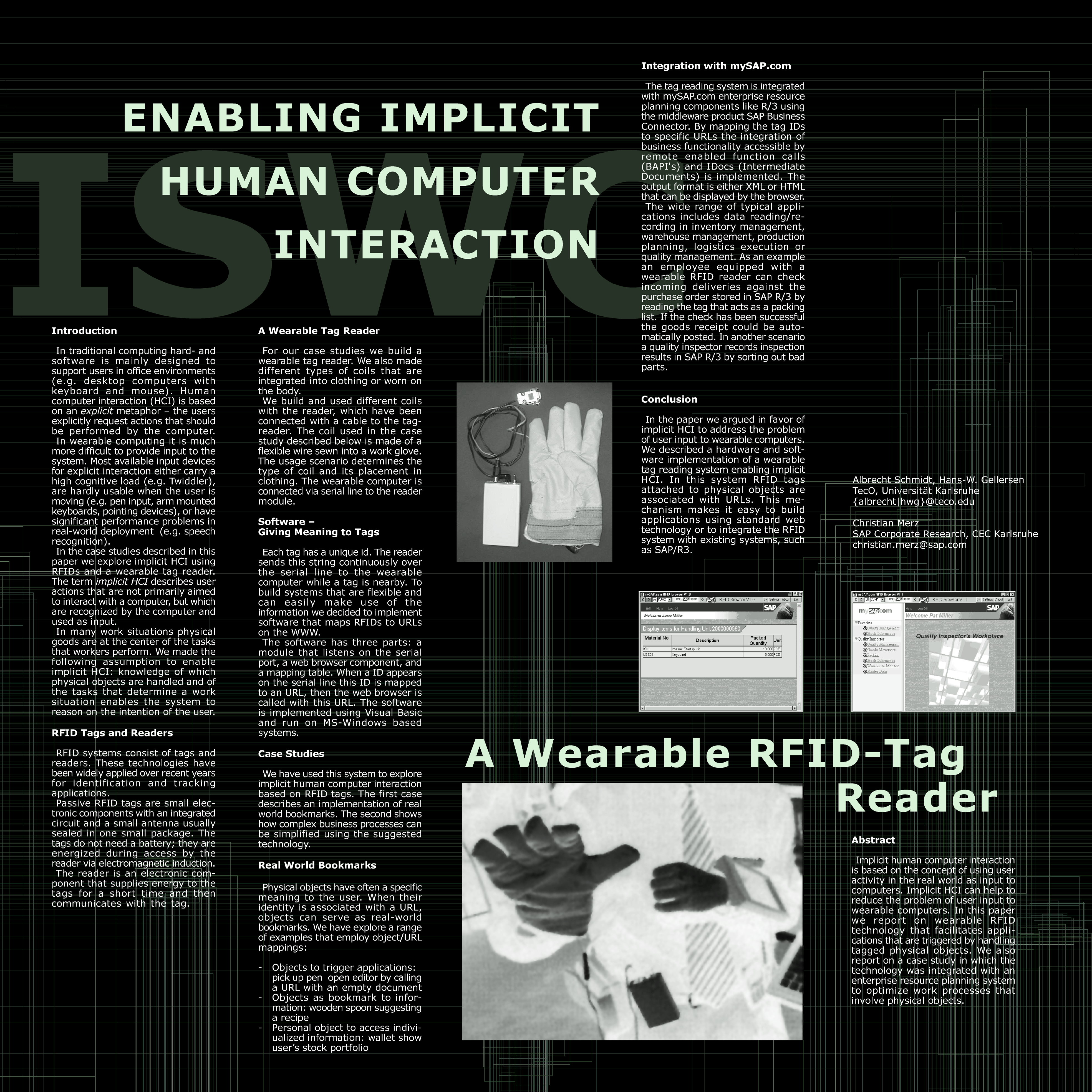
We did some work on the topic, too around that time - at RFID reader integrated in a glove - which resulted in a Poster at ISWC [4] and a patent [5].
[1] Want, R. 2006. An Introduction to RFID Technology. IEEE Pervasive Computing 5, 1 (Jan. 2006), 25. DOI= http://dx.doi.org/10.1109/MPRV.2006.2
[2] Harrison, B. L., Fishkin, K. P., Gujar, A., Portnov, D., and Want, R. 1999. Bridging physical and virtual worlds with tagged documents, objects and locations. In CHI '99 Extended Abstracts on Human Factors in Computing Systems (Pittsburgh, Pennsylvania, May 15 - 20, 1999). CHI '99. ACM, New York, NY, 29-30. DOI= http://doi.acm.org/10.1145/632716.632738
[3] Ljungstrand, P. and Holmquist, L. E. 1999. WebStickers: using physical objects as WWW bookmarks. In CHI '99 Extended Abstracts on Human Factors in Computing Systems (Pittsburgh, Pennsylvania, May 15 - 20, 1999). CHI '99. ACM, New York, NY, 332-333. DOI= http://doi.acm.org/10.1145/632716.632916
[4] Schmidt, A., Gellersen, H., and Merz, C. 2000. Enabling Implicit Human Computer Interaction: A Wearable RFID-Tag Reader. In Proceedings of the 4th IEEE international Symposium on Wearable Computers (October 18 - 21, 2000). ISWC. IEEE Computer Society, Washington, DC, 193. (Poster as large PNG)
[5] US Patent 6614351 - Computerized system for automatically monitoring processing of objects. September 2, 2003. http://www.patentstorm.us/patents/6614351/description.html
 We use the hardware from http://nabaztag.com/ (Ztamp:s and Mir:ror) as the focus is on the concept and application and not on the underlying technology. To ease development Florian and Ali have developed a little system that offers WebCallBacks (students can register a URL and that is called when a tag is read).
Linking by tagging of objects has been well explored, e.g. [2] and [3], and I think it is about time that this technologies will make an impact in the consumer market - the technology gets cheap enough now (and perhaps one of our students has a great idea).
 Some years back (in the last millennium) a company tried to push linking of paper adverts and digital content with the CueCat (http://en.wikipedia.org/wiki/CueCat) - I was impressed and inspired at that time but in my view it had two major weaknesses: (1) technically too early and (2) encoding of serial numbers instead of URLs. The RadioShack catalog and the Wired Magazine that included codes showed the potential - but it was too cumbersome as it was restricted to the PC …
We did some work on the topic, too around that time - at RFID reader integrated in a glove - which resulted in a Poster at ISWC [4] and a patent [5].
[1] Want, R. 2006. An Introduction to RFID Technology. IEEE Pervasive Computing 5, 1 (Jan. 2006), 25. DOI= http://dx.doi.org/10.1109/MPRV.2006.2
[2] Harrison, B. L., Fishkin, K. P., Gujar, A., Portnov, D., and Want, R. 1999. Bridging physical and virtual worlds with tagged documents, objects and locations. In CHI '99 Extended Abstracts on Human Factors in Computing Systems (Pittsburgh, Pennsylvania, May 15 - 20, 1999). CHI '99. ACM, New York, NY, 29-30. DOI= http://doi.acm.org/10.1145/632716.632738
[3] Ljungstrand, P. and Holmquist, L. E. 1999. WebStickers: using physical objects as WWW bookmarks. In CHI '99 Extended Abstracts on Human Factors in Computing Systems (Pittsburgh, Pennsylvania, May 15 - 20, 1999). CHI '99. ACM, New York, NY, 332-333. DOI= http://doi.acm.org/10.1145/632716.632916
[4] Schmidt, A., Gellersen, H., and Merz, C. 2000. Enabling Implicit Human Computer Interaction: A Wearable RFID-Tag Reader. In Proceedings of the 4th IEEE international Symposium on Wearable Computers (October 18 - 21, 2000). ISWC. IEEE Computer Society, Washington, DC, 193. (Poster as large PNG)
[5] US Patent 6614351 - Computerized system for automatically monitoring processing of objects. September 2, 2003. http://www.patentstorm.us/patents/6614351/description.html
Wednesday, 24 June 2009
Human Computer Confluence - Information Day in Brussels
 By the end of the month FET Open will launch the call for the proactive initiative on Human Computer Confluence. The term is new and hopefully it will really lead to new ideas. Today was already an information day on the upcoming proactive initiatives. I arrived the evening before and it is always a treat to talk a walk in the city.
 The presentations were not really surprising and also the short intros by the participants remained very generic. Seeing the call that is now finalized and having been at the consultation meetings it seems to me that the focus is rather broad for a proactive initiative… but with many people wanting a piece of the cake this seems inevitable.
 I presented a short idea of "breaking space and time boundaries" - the idea is related to a previous post on predicting the future. The main idea is that with massive sensing (by a large number of people) and with uniform access to this information - independ of time and space - we will be able to create a different view of our realty. We think of putting a consortium together for an IP. Interested? Then give me a call.
Saturday, 20 June 2009
Happy Birthday - Prof. Thomas Christaller 60
 It was a great honor to be invited to Prof Thomas Christaller's 60th Birthday. During my time at Fraunhofer IAIS I had the pleasure of working with him and learning from him! He has many interests and skills! See his web page at Fraunhofer IAIS and at Lebenskunst.
The symposium at Schloß Birlinghoven featured an impressive list of people and I learned more about the history of German computer science. It is impressive to see that many people that shaped AI in Germany worked at some point together in one project (HAM-RPM, HAM-ANS, see [1]). This highlighted to me again the importance of education people in research and not just getting research done - as nicely described by Patterson in "Your students are your legacy" [2] - an article worthwhile to read for anyone advising students.
The afternoon and evening was much too short to catch up with everyone. It was great to meet Christian Bauckhage, who took over my office in Bonn, in person. He is now professor at B-IT and at Fraunhofer IAIS and I hope we have a chance to work together in the future. At WWW2009 he published a paper on a new approach to social network analysis [3] applied to Slashdot. This approach which discriminates negative and positive connections could also be an interesting approach in social networks that are grounded in the real world… seems there is already an idea for a joined project.
After telling Karl-Heinz Sylla that I am currently teaching a software engineering class he recommended me the following book: Clean Code: A Handbook of Agile Software Craftsmanship by Robert C. Martin [4]. The books looks good and one interesting argument is that programming well in the small (clean code) is a pre-requisite for large systems - or the other way round you break big software systems by bad programming in the small. Perhaps there is some time over the summer to read the book.
PS: Thomas chose an interesting option for birthday presents: bicycles for Africa - a quite remarkable project. I will see if I find the URL and post it in a comment...
[1] Wolfgang Hoeppner, Thomas Christaller, Heinz Marburger, Katharina Morik, Bernhard Nebel, Mike O'Leary, Wolfgang Wahlster: Beyond Domain-Independence: Experience With the Development of a German Language Access System to Highly Diverse Background Systems. IJCAI 1983: 588-594
[2] Patterson, D. A. 2009. Viewpoint
Your students are your legacy. Commun. ACM 52, 3 (Mar. 2009), 30-33. DOI= http://doi.acm.org/10.1145/1467247.1467259
[3] Kunegis, J., Lommatzsch, A., and Bauckhage, C. 2009. The slashdot zoo: mining a social network with negative edges. In Proceedings of the 18th international Conference on World Wide Web (Madrid, Spain, April 20 - 24, 2009). WWW '09. ACM, New York, NY, 741-750. DOI= http://doi.acm.org/10.1145/1526709.1526809
[4] Robert C. Martin. Clean Code: A Handbook of Agile Software Craftsmanship. Prentice Hall International. 2008 (Amazon-Link)
Friday, 12 June 2009
Steve Hinske defents his PhD Thesis at ETH Zurich
 "Sounds like a fun project" was my first reaction when I read some time back the first paper on Steve's work on augmented toys and augmented games. Reading through his thesis and seeing more of his papers it seems there was a lot of hard work, too.
 Thinking more about it I was wondering how toys are really going to change in the future and to what extent this is going to happen. Technically a lot is feasible as it is well demonstrated by Steve in his thesis (photo from www.vs.inf.ethz.ch); if you do not have time to read the thesis I recommend to look at two of his papers: [1] and [2]. They give a good overview of the systems he created. In the discussion we could see that there can be very interesting business model involving third party developers for such toys.
… but nevertheless the playing experience is something very special and I would bet the augmented toys will come but the ordinary non-augmented dolls will stay.
 PS: The cafeteria at ETH provided another example of my collection "if you need a sign/label - you have got the UI design wrong" - great example how gestalt law would have been so easy and arrows look so bad ;-)
[1] Hinske, S. and Langheinrich, M. 2009. W41K: digitally augmenting traditional game environments. In Proceedings of the 3rd international Conference on Tangible and Embedded interaction (Cambridge, United Kingdom, February 16 - 18, 2009). TEI '09. ACM, New York, NY, 99-106. DOI= http://doi.acm.org/10.1145/1517664.1517691
[2] Hinske, S., Langheinrich, M., and Lampe, M. 2008. Towards guidelines for designing augmented toy environments. InProceedings of the 7th ACM Conference on Designing interactive Systems (Cape Town, South Africa, February 25 - 27, 2008). DIS '08. ACM, New York, NY, 78-87. DOI= http://doi.acm.org/10.1145/1394445.1394454
Monday, 8 June 2009
Automotive UIs - conference update, cool UI
The automotive user interface conference has received nearly 40 (to be exact 37) high quality submissions - we are really thrilled about the contributions - and now the review process is on! We will have more details on the program in a number of weeks.

Not a submission to the conference - but nevertheless cool: the MINI center globe UI - a 3D display concept for cars:
http://www.youtube.com/watch?v=aSWr_Craqos (from 2:08)
Thursday, 4 June 2009
ebook, tangibe programming, iPhones bring back wired telephony
 Having used the Sony PRS-505 now for a few weeks (mainly to read dissertations and project reports) I have quickly gotten used to carrying less weight. The user interface requires some learning - as the screen is pretty slow pressing a button does not give immediate feedback and that feels strange - more than expected. I wonder if there are studies on traditional interacton with electronic paper? Another issue: it seems to depend on the crew whether or not it is OK to read from an eBook during the entire flight (including take-off and landing)...
While reading a thesis I was reminded of an interesting paper on tangible programming [1] from a special issue of Personal and Ubiquitous Computing we did in 2004. The paper situates the topic historically and gives an interesting introduction.
In recent meetings as well as in airports around the world one can observe a trend: wired telephony! Whereas people with traditional mobile phone walk up and down and talk on the phone iPhone users often sit wired up to the next power plug an phone... seems apple has re-invented wired telephony ;-) and other brands will soon follow (make sure to reserve a seat with a power connection).
[1] McNerney, T. S. 2004. From turtles to Tangible Programming Bricks: explorations in physical language design. Personal Ubiquitous Comput. 8, 5 (Sep. 2004), 326-337. DOI= http://dx.doi.org/10.1007/s00779-004-0295-6
Interesting articles in Wired Magazine
In Miami airport I picked up the current issue of the wired magazine - and Airberlin gave me plenty of time to read it - was nearly through when we finally departed after 2 hours without air condition in the plane :-(
Not really complaining as there is a set of inspiring articles about the digital economy:
hope you find a more comfortable place to read them ;-)
Not really complaining as there is a set of inspiring articles about the digital economy:
hope you find a more comfortable place to read them ;-)
Thursday, 28 May 2009
Statistical Data on phone usage and ICT
Ever wanted to cite the number of "Mobile cellular subscriptions per 100 inhabitance" in Albania, Algeria, Argentina, Armenia, Australia, …., United States, Uruguay, Uzbekistan, Venezuela, Viet Nam, Yemen, Zambia or Zimbabwe? Or the spending on mobile telephony or the computer penetration in these countries? Then the website I just came across may be interesting for you too: http://measuring-ict.unctad.org/
Here are the direct links to documents containing data:
MANUAL for Measuring ICT Access and Use by Households and Individuals
Here are the direct links to documents containing data:
- Measuring the Information Society - ICT Development Index
- The Global Information Society: a Statistical View
MANUAL for Measuring ICT Access and Use by Households and Individuals
Interessting tool to find flights…
Looking for a way to get from Essen (leaving not before 18:00) to Newcastle (arriving before 10:00 the next day) and going back from Newcastle (leaving not before 17:00) to Zürich (arriving before 10:00 the next day) Chis pointed me to a website that is very helpful for such tasks… (at least with the flying part of it): http://www.skyscanner.de
I wonder how hard it is to build a similar tool that takes further modes of transport (e.g. train and rental car) into account...
I wonder how hard it is to build a similar tool that takes further modes of transport (e.g. train and rental car) into account...
Wednesday, 20 May 2009
Morten Fjeld visiting
 On his way from Eindhoven to Zurich Morten Fjeld was visiting our group. It was great to catch up and talk about a number of exciting research projects and ideas. Some years ago one of my students from Munich did his final project with Morten working on haptic communication ideas, see [1]. Last year at TEI Morten had a paper on a related project - also using actuated sliders, see [2].
In his presentation Morten gave an overview of the research he does and we found a joint interest in capacitive sensing. Raphael Wimmer did his final project in Munich on capacitive sensing for embedded interaction which was published in Percom 2007, see [3]. Raphael has continued the work for more details and the open source hardware and software see http://capsense.org. Morten has a cool paper (combing a keyboard and capacitive sensing) at Interact 2009 - so check the program when it is out.
 We talked about interaction and optical tracking and that reminded me that we wanted to see how useful the touchless SDK (http://www.codeplex.com/touchless) could be for final projects and exercise. Matthias Kranz had used it successfully with students in Linz in the unconventional user interfaces class.
[1] Jenaro, J., Shahrokni, A., Schrittenloher, and M., Fjeld, M. 2007. One-Dimensional Force Feedback Slider: Digital platform. In Proc. Workshop at the IEEE Virtual Reality 2007 Conference: Mixed Reality User Interfaces: Specification, Authoring, Adaptation (MRUI07), 47-51
[2] Gabriel, R., Sandsjö, J., Shahrokni, A., and Fjeld, M. 2008. BounceSlider: actuated sliders for music performance and composition. In Proceedings of the 2nd international Conference on Tangible and Embedded interaction (Bonn, Germany, February 18 - 20, 2008). TEI '08. ACM, New York, NY, 127-130. DOI= http://doi.acm.org/10.1145/1347390.1347418
[3] Wimmer, R., Kranz, M., Boring, S., and Schmidt, A. 2007. A Capacitive Sensing Toolkit for Pervasive Activity Detection and Recognition. In Proceedings of the Fifth IEEE international Conference on Pervasive Computing and Communications (March 19 - 23, 2007). PERCOM. IEEE Computer Society, Washington, DC, 171-180. DOI= http://dx.doi.org/10.1109/PERCOM.2007.1
Thursday, 14 May 2009
SEGA World - relaxing after the conference :-)
On the way back from the PC-dinner we needed to get an update on another aspect of Japanese technologies and so we went into SEGA World in Nara.
Many of the games are very similar to other toys around the world - shooter, sports games and racing games. Each time you use games in such a setting one is reminded of the power a physical controls and the concept of tangible interaction...

The photo maker however was very different from what I have seen before. Technically it is interesting and well engineered: you make photos in a well lit area, it removes the background, and then you can choose background, borders, frames etc. Marc's Japanese helped us to get our pictures out of the machine - with more time an more Japanese reading skill we could have manipulated our pictures some more. It was interesting that the machine offered two options for output: paper and transfer to your mobile phone.
 PS: remember not to play basketball against James and not to race against Antonio ;-)
Many of the games are very similar to other toys around the world - shooter, sports games and racing games. Each time you use games in such a setting one is reminded of the power a physical controls and the concept of tangible interaction...

The photo maker however was very different from what I have seen before. Technically it is interesting and well engineered: you make photos in a well lit area, it removes the background, and then you can choose background, borders, frames etc. Marc's Japanese helped us to get our pictures out of the machine - with more time an more Japanese reading skill we could have manipulated our pictures some more. It was interesting that the machine offered two options for output: paper and transfer to your mobile phone.
 PS: remember not to play basketball against James and not to race against Antonio ;-)
Rubber-like stretchable display
Jörg just sent me a link on a rubber-like stretchable display that is published in Nature Material. There is a previous press release with some photos [2]. This is a significant step towards new nteractive devices, such as the one suggested in the GUMMI project [3].
[1] Stretchable active-matrix organic light-emitting diode display using printable elastic conductors, Tsuyoshi Sekitani et al., Nature Materials, doi: 10.1038/nmat2459
http://www.nature.com/nmat/journal/vaop/ncurrent/abs/nmat2459.html
[2] http://www.ntech.t.u-tokyo.ac.jp/Archive/Archive_press_release/press_stretchable/documents/press_release_en.pdf
[3] Schwesig, C., Poupyrev, I., and Mori, E. 2004. Gummi: a bendable computer. In Proceedings of the SIGCHI Conference on Human Factors in Computing Systems (Vienna, Austria, April 24 - 29, 2004). CHI '04. ACM, New York, NY, 263-270. DOI= http://doi.acm.org/10.1145/985692.985726
[1] Stretchable active-matrix organic light-emitting diode display using printable elastic conductors, Tsuyoshi Sekitani et al., Nature Materials, doi: 10.1038/nmat2459
http://www.nature.com/nmat/journal/vaop/ncurrent/abs/nmat2459.html
[2] http://www.ntech.t.u-tokyo.ac.jp/Archive/Archive_press_release/press_stretchable/documents/press_release_en.pdf
[3] Schwesig, C., Poupyrev, I., and Mori, E. 2004. Gummi: a bendable computer. In Proceedings of the SIGCHI Conference on Human Factors in Computing Systems (Vienna, Austria, April 24 - 29, 2004). CHI '04. ACM, New York, NY, 263-270. DOI= http://doi.acm.org/10.1145/985692.985726
Subscribe to:
Posts (Atom)