Showing posts with label pervasive. Show all posts

Friday, 23 July 2010

Teaching Ubicomp? What is it we should teach?

Why should we teach Ubicomp? What are the core issues when teaching Ubicomp? How do we cope with the rapid changes in technologies if we provide practical exercises in our Pervasive Computing classes? What skills will students take away from the course?

As Ubicomp is still a young and dynamic subject it is inevitable that we have to ask these questions. To share our experiences in teaching we met at the ETH Zürich. Friedemann Mattern, Marc Langheinrich, Michael Rohs, Kay Römer, and many of our PhD students (and me ;-) spent two days in Zürich to collect materials and discuss the above questions. The hardest one is obviously the what is ubicomp question…

For me the key thing is that we teach about distributed computing systems that are aware and linked to the real world and which are used by humans. The systems aspect is key and I think which specific technologies, tools, methods, we teach are exchangeable. The second point I want to make in my pervasive computing class is to get students excited and aware of the potential of computing in the future and how we are at the heart of a major change that goes beyond technology.

We are currently compiling a Wiki with teaching materials which we hope will become public in the future (at least in parts). If you teach a ubicomp related course or if you know of course please feel free to add a comment with link to the webpage and we will try to include it in the collection.

PS: examples of the UI challenge of ubicomp are everywhere.

Thursday, 25 June 2009

Linking the activities in the physical world to actions in the digital/virtual

Currently we have an assignment in our Pervasive Computing class that asks students to design and develop a system where actions are associated with artifacts. Technically students should develop a web based solution using RFID. Apropos RFID, … if you look for a good introduction on RFID read Roy Want's IEEE Pervasive Magazin paper [1].

We use the hardware from http://nabaztag.com/ (Ztamp:s and Mir:ror) as the focus is on the concept and application and not on the underlying technology. To ease development Florian and Ali have developed a little system that offers WebCallBacks (students can register a URL and that is called when a tag is read).

Linking by tagging of objects has been well explored, e.g. [2] and [3], and I think it is about time that this technologies will make an impact in the consumer market - the technology gets cheap enough now (and perhaps one of our students has a great idea).

Some years back (in the last millennium) a company tried to push linking of paper adverts and digital content with the CueCat (http://en.wikipedia.org/wiki/CueCat) - I was impressed and inspired at that time but in my view it had two major weaknesses: (1) technically too early and (2) encoding of serial numbers instead of URLs. The RadioShack catalog and the Wired Magazine that included codes showed the potential - but it was too cumbersome as it was restricted to the PC …

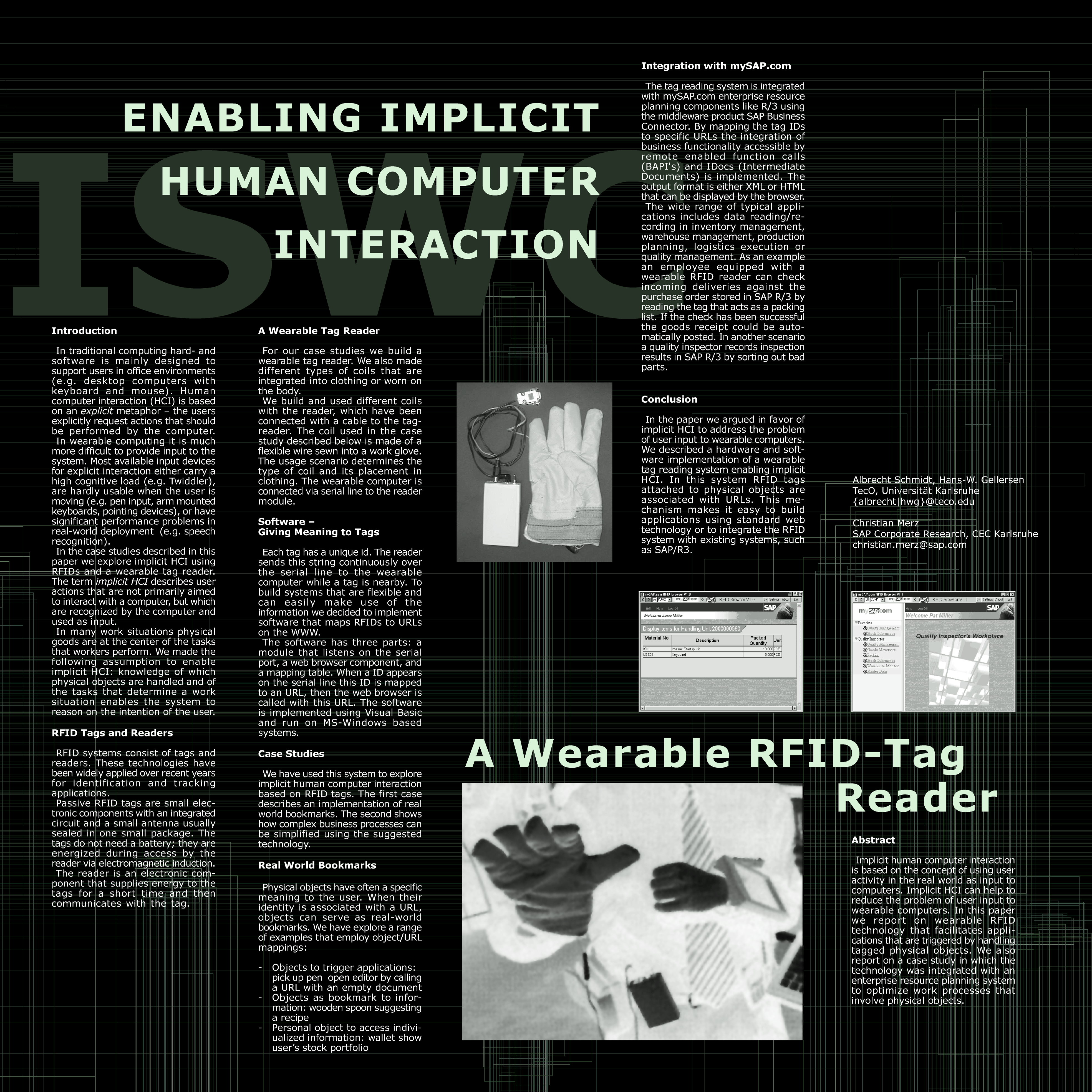
We did some work on the topic, too around that time - at RFID reader integrated in a glove - which resulted in a Poster at ISWC [4] and a patent [5].

[1] Want, R. 2006. An Introduction to RFID Technology. IEEE Pervasive Computing 5, 1 (Jan. 2006), 25. DOI= http://dx.doi.org/10.1109/MPRV.2006.2

[2] Harrison, B. L., Fishkin, K. P., Gujar, A., Portnov, D., and Want, R. 1999. Bridging physical and virtual worlds with tagged documents, objects and locations. In CHI '99 Extended Abstracts on Human Factors in Computing Systems (Pittsburgh, Pennsylvania, May 15 - 20, 1999). CHI '99. ACM, New York, NY, 29-30. DOI= http://doi.acm.org/10.1145/632716.632738

[3] Ljungstrand, P. and Holmquist, L. E. 1999. WebStickers: using physical objects as WWW bookmarks. In CHI '99 Extended Abstracts on Human Factors in Computing Systems (Pittsburgh, Pennsylvania, May 15 - 20, 1999). CHI '99. ACM, New York, NY, 332-333. DOI= http://doi.acm.org/10.1145/632716.632916

[4] Schmidt, A., Gellersen, H., and Merz, C. 2000. Enabling Implicit Human Computer Interaction: A Wearable RFID-Tag Reader. In Proceedings of the 4th IEEE international Symposium on Wearable Computers (October 18 - 21, 2000). ISWC. IEEE Computer Society, Washington, DC, 193. (Poster as large PNG)

[5] US Patent 6614351 - Computerized system for automatically monitoring processing of objects. September 2, 2003. http://www.patentstorm.us/patents/6614351/description.html

Thursday, 14 May 2009

Some Interesting Papers and random Photos from Pervasive 2009

Pervasive 2009 had a really exciting program and provided a good overview of current research in pervasive and ubiquitous computing. Have a look at the proceedings of the pervasive 2009 conference. The Noh theater in Nara was a very special and enjoyable venue and it was organized perfectly - as one would expect when travelling to Japan.

The idea of having short and long papers together in the main track worked very well in my view. The number of demos and posters was much higher than in the years before - and that was great and very inspiring. Have a look at the photos for some of the posters and demos.
The program consisted of 20 full papers (18 pages) and 7 notes (8 pages) which were selected in a peer review process out of 147 submissions (113 full papers, 34 notes) which is a acceptance rate of 18%.

John Krumm presented his paper Realistic driving tips for location privacy - again having a good idea making the presentation interesting beyond its content (having review snippets in the footer of the slides - including a fake review). The paper explores the difficulties that arise when creating fake GPS tracks. He motivated that the probabilities need to be taken into account (e.g. you are usually on a road). I liked the approach and the paper is worthwhile to read. I think it could be interesting to compare the approach is not create the tracks but just share them between users (e.g. other people can use parts of my track as fake track and in return I get some tracks that I can use as fake tracks). http://dx.doi.org/10.1007/978-3-642-01516-8_4

If you phone knows where you are you can use this information to control your heating system. This was the basic idea of the research presented by Stephen Intille. They explored using GPS location of the users to automate control of the heating / air condition control in a house. It seems there is quite some potential for saving energy with technology typically used in the US (one temperature control for the whole house). In Europe where heating systems typically offer finer control (e.g. room level) the potential is probably larger.
http://dx.doi.org/10.1007/978-3-642-01516-8_8

James Scott presented a paper that showed how you can use force gestures to interact with a device. In contrast to previous research (e.g. GUMMI) the approach works with a ridged device and could be used with current screen technologies.
http://dx.doi.org/10.1007/978-3-642-01516-8_10

What do you need to figure out who is holding and using the remote control? This question is addressed in the paper "Inferring Identity Using Accelerometers in Television Remote Controls" that was presented by Jeff Hightower. They looked at how well button press sequences and accelerometer data give you information about which person is using the device.
http://dx.doi.org/10.1007/978-3-642-01516-8_11

Geo-fencing: confining Wi-Fi Coverage to Physical Boundaries is an example of how to create technological solutions to fit a user's conceptual model of the world. As people have experience with the physical world and they have mechanisms to negotiate and use space and hence linking technologies that have typically other characteristics (e.g. wireless radio coverage) to the known concept is really interesting.
http://dx.doi.org/10.1007/978-3-642-01516-8_19

Situvis, a tool for visualizing sensor data, was presented by Adrian Clear from Aaron's group in Dublin. The software, papers and a video is available at: http://situvis.com/. The basic idea is to have a parallel coordinate visualization of the different sensor information and to provide interaction mechanisms with the data.
http://dx.doi.org/10.1007/978-3-642-01516-8_22

Nathan Eagle presented the paper "Methodologies for continuous cellular tower data analysis". He talked about the opportunities that arise when we have massive amounts of information from users - e.g. tracks from 200 million mobile phone user. It really is interesting that based on such methods we may get completely new insights into human behavior and social processes.
http://dx.doi.org/10.1007/978-3-642-01516-8_23

If you have seen a further interesting paper in the conference (and there are surely some) that I have missed feel free to give a link to them in the comments to this post.

Tuesday, 13 January 2009

CfP Workshop on Pervasive Advertising

We organize at this year's Pervasive computing conference in Nara, Japan a workshop on Pervasive Advertising - http://pervasiveadvertising.org

We expect that there is a lot of interesting research going on in the area and it is clearly a controversial topic. Being an optimist - I see the new options that arise. In particular a future with less annoying advertisements is one hope :-)

But many people are focusing on the risks that arise - an interesting positing with some criticism of our workshop objective can be found at the near future laboratory  I do not share their views :-)

To me the idea that if you do not research it, it does not happen seems not a very viable option. I still think with research we can shape the future!

I am already looking forward to the submission and to the workshop. You have a contribution? Deadline is Feb, 11 2008.

Sunday, 23 November 2008

Information vs. Mobility, Percom PC meeting in New York

The PC meeting for Percom 2009 took place at IBM in Hawthorne, NY. Percom had about 200 submissions and many good ones - so we could compile an exciting program across the whole field of pervasive computing and communication. As one of three program vice chairs I have looked in detail in about 1/3 of the submissions that were application related. It is interesting to observe that research as a whole in the field becomes more major and at the same time more incremental. 

To me this puts up the big question in which domains will the new big innovations happen, what is the next trend after we have pervasive computing? There are luckily plenty of options, but at the moment it seems that there develops an interesting relationship between information, communication, mobility and energy. It seems that we can compensate mobility by information and communication and similarly we can reduce energy required by information available. One example is: if I know where things are (=information) I can reduce the effort required to find them (=mobility). Is there more to it?

Each time in the US - even in New York were public transport works quite well - one is surprise how alien it appears to many that it could be an option to take public transport on a business trip (e.g. there are no first class coaches on regional trains). Flying from Düsseldorf into Newark it was convenient to take the train to Penn Station in NY City and then an express train to White Plaines. If we would not have gone for a walk in the city we probably would have been equally fast as by car. With the again low gas prices in the US (less than 2U$ per gallon, down from 4 just a few month ago) I would expect public transport and small cars will not gain too much popularity - before the next rise in gas prices.

PS: it is amazing how many possiblities there are to serve coffee (and this is probably not one of the most environment friendly)

Thursday, 10 July 2008

Visitors to our Lab

Christofer Lueg (he is professor at the School of Computing & Information Systems at the University of Tasmania) and Trevor Pering (he is a senior researcher at Intel Research in Seattle) visited our lab this week. The timing is not perfect but at I am not the only interesting person in the lab ;-)

Together with Roy Want and others Trevor published some time ago an article in the IEEE Pervasive Magazine that is still worthwhile to read “Disappearning Hardware” [1]. It shows clearly the trend that in the near future it will be feasible to include processing and wireless communication into any manufactured product and outlines resulting challenges. One of those challenges which we look into in our lab is how to interact with such systems… Also in a 2002 paper Christopher raised some very fundamental questions how far we will get with intelligent devices [2].

[1] Want, R., Borriello, G., Pering, T., and Farkas, K. I. 2002. Disappearing Hardware. IEEE Pervasive Computing 1, 1 (Jan. 2002), 36-47. DOI= http://dx.doi.org/10.1109/MPRV.2002.993143

[2] Lueg, C. 2002. On the Gap between Vision and Feasibility. In Proceedings of the First international Conference on Pervasive Computing (August 26 - 28, 2002). Lecture Notes In Computer Science, vol. 2414. Springer-Verlag, London, 45-57.

Saturday, 5 July 2008

How to proof that Ubicomp solutions are valid?

Over the last years there have been many workshops and sessions in the ubicomp community that address the evaluation of systems. At Pervasive 2005 in Munich I co-organized a workshop on Application led research with George Coulouris and others. For me one of the central outcomes was that we – as ubicomp researchers – need to team up in evaluating our technologies and solutions with experts in the application domain and that we stay involved in this part of the research. Just handing it over for evaluation into the other domain will not bring us the insights we need to move the field forward. There is a workshop report which appeared in the IEEE Pervasive Magazine, that discusses the topic in more detail [1].

On Friday I met we a very interesting expert in the domain of gerontology. Elisabeth Steinhagen-Thiessen is chief consultant and director of the protestant geriatric centre of Berlin and professor of internal medicine/gerontology at the Charite in Berlin. We talked about opportunities for activity recognition in this domain and discussed potential set-ups for studies.

[1] Richard Sharp, Kasim Rehman. What Makes Good Application-led Research? IEEE Pervasive Computing Magazin. Volume 4, Number 3. July-September 2005.

Thursday, 19 June 2008

Birthday candles going electronic

What is a birthday cake without a candle? Sometimes it is hard to find a candle but having a creative team there is always a solution – less than 3 minutes away ;-) As always with new technologies – after deployments ideas for Version 2 (which will include much more functionality) emerge… An there was another business idea – interactive wedding cakes – perhaps we explore this later this year ;-)

Wednesday, 18 June 2008

Teaching in primary school, digital photography, civilization

I had a day off an was as “teaching assistant” on a school trip with the kids my wife is teaching. The trip went to a museum village (Wackershofen), which tries to preserve and communicate how people lived about 100 years ago.

On side observation was that in digital photography the limiting factor is now not anymore the memory space but the batteries in the camera. This has changed over the last 2 years – there children still selected which pictures they have to delete – now that is no issue anymore. This shows that some of the trends in pervasive computing (in this case unlimited memory) is already there…

In a project we converted manually flax into threads and theoretically into linen fabric. Some years ago I was involved in doing a similar project - with a focus on the multimedia docummentation - also with a primary school. We learned that it took a person one winter to make one piece of garment. Putting this into perspective we see an interesting trend of devaluation of physical object (cloth are one example, but applies also to high tech goods such as MP3 players) due to advances in engineering. This devaluation of physical goods led to a higher standard of living and consequently to a higher life expectancy. I wonder how further advances – especially in digital engineering will affect the quality of life…

Friday, 23 May 2008

Impressions from Pervasive 2008

Using electrodes to detect eye movement and to detect reading [1] – relates to Heiko’s work but uses different sensing techniques. If the system can really be implemented in goggles this would be a great technologies for eye gestures as suggested in [2].

Utilizing infrastructures that are in place for activity sensing – the example is a heating/air condition/ventilation system [3]. I wondered and put forward the question how well this would work in active mode – where you actively create an airflow (using the already installed system) to detect the state of an environment.


Further interesting ideas:

  • Communicate while you sleep? Air pillow communication… Vivien loves the idea [4].

  • A camera with additional sensors [5] – really interesting! We had in Munich a student project that looked at something similar [6]

  • A cool vision video of the future is SROOM – everything becomes a digital counterpart. Communicates the idea of ubicomp in a great and fun way [7] – not sure if the video is online – it is on the conference DVD.

[1] Robust Recognition of Reading Activity in Transit Using Wearable Electrooculography. Andreas Bulling, Jamie A. Ward, Hans-W. Gellersen and Gerhard Tröster. Proc. of the 6th International Conference on Pervasive Computing (Pervasive 2008), pp. 19-37, Sydney, Australia, May 2008. http://dx.doi.org/10.1007/978-3-540-79576-6_2

[2] Heiko Drewes, Albrecht Schmidt. Interacting with the Computer using Gaze Gestures. Proceedings of INTERACT 2007. http://murx.medien.ifi.lmu.de/~albrecht/pdf/interact2007-gazegestures.pdf

[3] Shwetak N. Patel, Matthew S. Reynolds, Gregory D. Abowd: Detecting Human Movement by Differential Air Pressure Sensing in HVAC System Ductwork: An Exploration in Infrastructure Mediated Sensing. Proc. of the 6th International Conference on Pervasive Computing (Pervasive 2008), pp. 1-18, Sydney, Australia, May 2008. http://shwetak.com/papers/air_ims_pervasive2008.pdf

[4] Satoshi Iwaki et al. Air-pillow telephone: A pillow-shaped haptic device using a pneumatic actuator (Poster). Advances in Pervasive Computing. Adjunct proceedings of the 6th International Conference on Pervasive Computing (Pervasive 2008). http://www.pervasive2008.org/Papers/LBR/lbr11.pdf

[5] Katsuya Hashizume, Kazunori Takashio, Hideyuki Tokuda. exPhoto: a Novel Digital Photo Media for Conveying Experiences and Emotions. Advances in Pervasive Computing. Adjunct proceedings of the 6th International Conference on Pervasive Computing (Pervasive 2008). http://www.pervasive2008.org/Papers/Demo/d4.pdf

[6] P. Holleis, M. Kranz, M. Gall, A. Schmidt. Adding Context Information to Digital Photos. IWSAWC 2005. http://www.hcilab.org/documents/AddingContextInformationtoDigitalPhotos-HolleisKranzGallSchmidt-IWSAWC2005.pdf

[7] S-ROOM: Real-time content creation about the physical world using sensor network. Takeshi Okadome, Yasue Kishino, Takuya Maekawa, Kouji Kamei, Yutaka Yanagisawa, and Yasushi Sakurai. Advances in Pervasive Computing. Adjunct proceedings of the 6th International Conference on Pervasive Computing (Pervasive 2008). http://www.pervasive2008.org/Papers/Video/v2.pdf

Tuesday, 20 May 2008

Paul presented our paper at Pervasive 2008

Paul presented after lunch our full paper on a development approach and environment for mobile applications that supports underlying user models [1]. In the paper he shows how you can create applications while programming by example where the development environment automatically adds a KLM model. In this way the developer becomes automatically aware of estimated usage times for the application. The paper is work that builds on our paper on KLM for physical mobile interaction which was presented last year at CHI [2]. The underlying technology is the embedded interaction toolkit [3] – have a look – perhaps it makes you applications easier, too.

[1] Paul Holleis, Albrecht Schmidt: MAKEIT: Integrate User Interaction Times in the Design Process of Mobile Applications. In: Proceedings of the Sixth International Conference on Pervasive Computing, Pervasive'08. Sydney, Australia 2008, S. 56-74.

[2] Holleis, P.; Otto, F.; Hußmann, H.; Schmidt, A.: Keystroke-Level Model for Advanced Mobile Phone Interaction. In: Proceedings of the SIGCHI Conference on Human Factors in Computing Systems (San Jose, California, USA, April 28 - May 03, 2007). CHI '07. ACM Press, New York, NY, 1505-1514.. 2007.

Opening of Pervasive 2008

This morning the pervasive 2008 conference started in Sydney. The conference hotel is in the heart of the city at Darling Habour. As in recent years the conference is very competitive (acceptance rate of about 16%) and features interesting technologies and high quality research.

The program with links to Springer-Link is available at http://www.pervasive2008.org/Program/
One presentation included a slide with a quote about the technology he created in the project – will not tell which paper/author it is. Look in the proceedings and pick your favorite. This quote seems questionable at first – but it describes the essence in the difficulty of creating new technologies ;-)

Monday, 19 May 2008

Workshop on Smart Homes at Pervasive 2008

Today we had our Pervasive at home workshop – as part of Pervasive 2008 in Sydney. We had 7 talks and a number of discussions on various topics related to smart homes. Issues ranged from long term experience with smart home deployments (Lasse Kaila et al.), development cycle (Aaron Quigley et al.), to end-user development (Joëlle Coutaz). For the full workshop proceedings see [1].

One trend that can be observed is that researchers move beyond the living lab. In the discussion it became apparent that living labs can start research efforts in this area and function as focus point for researchers with different interests (e.g. technology and user-centred). However it was largely agreed that this can only be a first step and that deployments in actual home settings are becoming more essential to make an impact.

On central problem in smart home research is to develop future devices and services – where prototyping is based on current technologies and where we extrapolate from currently observed user behavior. We had some discussion how this can be done most effectively and what value observational techniques add to technology research and vice versa.

We discussed potential options for future smart home deployments and I suggested creating a hotel where people can experience future living and agree at the same time to give away their data for research purpose. Knowing what theme-hotels are around this idea is not as strange as it sounds ;-) perhaps we have to talk to some companies and propose this idea…

More of the workshop discussion is captured at: http://pervasivehome.pbwiki.com/

There are two interesting references that came up in discussions that I like to share. First the smart home at Duke University (http://www.smarthome.duke.edu/), which is dorm that is a live-in laboratory at Duke University – and it seems it is more expensive that the regular dorm. The second is an ambient interactive device, Joelle Coutaz discussed in the context of her presentation on a new approach to end-user programming and end-user development. The Nabaztag (http://www.nabaztag.com/) is a networked user interface that includes input and output (e.g. text2speech, moveable ears and LEDs) which can be programmed. I would be curious how well it really works to get people more connected – which relates to some ideas of us on having an easy communication channels.

[1] A.J. Brush, Shwetak Patel, Brian Meyers, Albrecht Schmidt (editors). Proceedings of the 1st Workshop on “Pervasive Computing at Home” held at the 6th international Conference on Pervasive Computing, Sydney, May 19 2008. http://murx.medien.ifi.lmu.de/~albrecht/pdf/pervasive-at-home-ws-proceedings-2008.pdf

Friday, 7 March 2008

Application Workshop of KDUbiq in Porto

After having frost and snow yesterday morning in Germany being in Porto (Portugal) is quite a treat. The KDubiq application workshop is in parallel to the summer school and yesterday evening it was interesting to meet up with some people teaching there.

The more I learn about data mining and machine learning the more I see even greater potential in many ubicomp application domains. In my talk “Ubicomp Applications and Beyond - Research Challenges and Visions” I looked back at selected applications and systems that we have developed over the last 10 year (have a look at the slides – I, too was surprised what variety of projects we did in the last years ;-). So far we have often used basic machine learning methods to implement – in many cases creating a version 2 of these systems where machine learning research is brought together with ubicomp research and new technology platforms could make a real difference.

Alessandro Donati from ESA gave a talk “Technology for challenging future space missions” which introduced several challenges. He explained their approach to technology introduction into mission control. The basic idea is that the technology providers create together with the users a new application or tool. He strongly argued for a user centred design and development process. It is interesting to see that the concept of user centred development processes are becoming more widespread and go beyond classical user interfaces into complex system development.

Tuesday, 12 February 2008

Visit at the TU Eindhoven

Elise van den Hoven, the program co-chair of TEI08, organized the printing of the proceeding. We went there on Tuesday to collect the books – quite a heavy load! The books look really good and the cover is great.

In the afternoon I gave a lecture with the title “Interacting with Pervasive Computing Systems”. I have related some of our recent work and ideas to the focus of the course which is “intelligent systems, products and related services”. In particular I asked to re-think how we can find a balance between user needs and technology push – without compromising a fruitful user centred design and development process. We continued this discussion with prof. Berry Eggen at dinner in a quite nice restaurant in town.

A further issue in my talk was to design interactive products and services that they fit their purpose very well – but that beyond this they allow for creative use. As an example I showed a set of photos I took with my phone. Some are in categories (e.g. preserving memory) that were probably anticipated by the designers whereas others (e.g. a WIFI-access code with I took a photo of not to have it to write down) are creative use. This observation again leads to the previous discussion on technology push and user need.

Being still new to the Ruhrgebiet and having not brush up on regional geography I was very much surprised how close Eindhoven is to Essen. Perhaps there is a chance for more collaboration in the future.

Thursday, 17 January 2008

The real world is complex and fast – visit to a hospital

In contrast to us people in the medical domain seem to start early in the morning. In the process of preparing a project proposal we visited the Elisabeth Hospital in Essen. We got the chance to see some invasive heart exams first hand.

It is impressive how well such complex processes run and how quick the staff can assess the conditions. Looking for potential to make theses processes easier is a touch challenges - espcially if you do not do this by sitting at your desk but if you want it to be realistic. In the discussion with the head nurse it became apparent that user centred design is probably the only way to really make a difference.

Processes are structures but nevertheless the real world is complex and messy. One thing we saw even in our short visit is that technology introduced must not make things slower – not even a single step.

In our conclusion we found a number of interesting issues – in particular with regard to the electronic patient record – that are worth while to push forward.

Monday, 7 January 2008

Great Conference – Great Wine

Gabi Kotsis produced at dinner one of the rarest bottles of wine – an original Pervasive 2004 wine (Alois Ferscha had it made extra for the conference and he designed the label, too) – and she opened it!

The wine is great. It brought back some memories of a very intersting doctoral colloquium in Linz and a splendid conference in the Vienna Hofburg with an excellent scientific program. Somehow I remember that after one evening (and some conference wine) I agreed to run Pervasive 2005 in Munich…

As we have quite a good number of registrations for TEI'08 in Bonn I probably should also think of a good wine for the dinner?

Sunday, 16 December 2007

Video conferences – easier but not better?

The Pervasive 2008 TPC meeting on Saturday was held distributed over 3 continents and linked via video conference. In Germany we had a really good time slot (12:00 to 20:00) – Australia and California had a really late/early day.

The meeting worked well over video and considering the saved travel time it seems this is a acceptable alternative to a full physical meeting. It was interesting to see that the video conferencing quality did not really improve much over the last years. We ran the TPC meeting for Ubicomp 2003 between the UK and the USA also with a video conference system. And my first projects (in 1996) I worked on as a student researcher at the University of Ulm were on video conferencing, too.

It seems that over the last 10 years it has gotten much easier to set a conference up and interoperability seems less of issue, but the quality is still poor (even with the professional systems). I wonder if we should look with a master thesis into the topic again – all the topics like high quality AV, context-awareness, sharing, informal exchange, side channels, etc. appear still not to be there yet… or is the setting we used (google docs for sharing, edas as document repository, skype for side channel communication, and a professional video conference system) the natural way this develops?

Saturday, 29 September 2007

Moving to the University of Duisburg-Essen


From Monday on I will be at the University of Duisburg-Essen. After a little less than a year in Bonn a new challenge is ahead: setting up a new group on Pervasive Computing and User Interface Engineering.

The lab will be situated at the campus in Essen (Schützenbahn 70) in the heart of the city. Our group will be in the Institute for Computer Science and Business Information Systems in the faculty of Economics. Teaching starts in the winter term with a lecture on User Interface Engineering and several project oriented courses.

The focus will be on systems, user interfaces and novel applications in the domain of pervasive and ubiquitous computing.

Thursday, 23 August 2007

Tico Ballagas defended his PhD in Aachen, New insight on Fitts' law.

Today I finally got around visiting Jan Borchers (media computing group at RWTH Aachen). Tico Ballagas hat as part of his PhD defence a public talk and took the chance to go there.

There where new parts in the talk on the impact of the selection space resolution on Fitts’s law that I had not seen in his work before. It is published in 2006 as a technical report (Rafael Ballagas and Jan Borchers. Selexels: a Conceptual Framework for Pointing Devices with Low Expressiveness. Technical Report AIB-2006-16, RWTH Aachen, Dec 2006) which is worthwhile to have a look at. This could be very interesting and relevant for the work Heiko Drewes does on eye-gaze interaction. Discriminating between input and output space for the index of difficulty could be helpful to understand better the impact of the errors that we see in eye gaze interaction.

One part of Tico’s research was concerned with a definition of a design space for input devices. This is partly described in a paper in IEEE Pervasive magazine, see: Ballagas, R., Borchers, J., Rohs, M., Sheridan, J.G., The Smart Phone: A Ubiquitous Input Device. IEEE Pervasive Computing 5(1). 70-77. 2006.