Monday, 22 September 2008

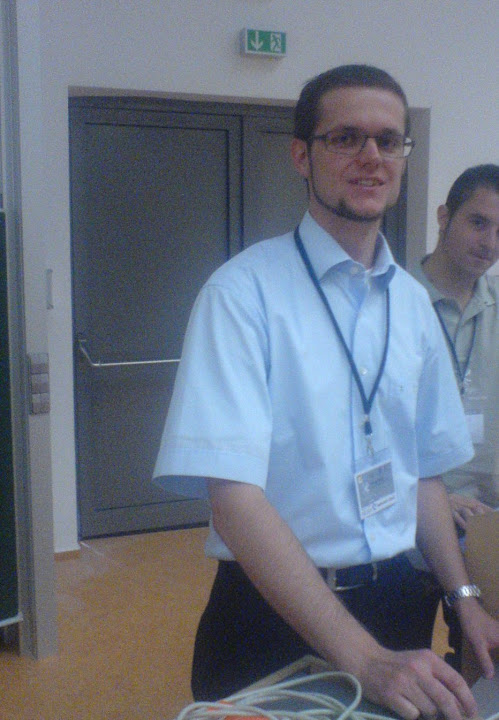
Keynote at Ubicomp 2008, Dr. Shim Yoon

The opening keynote at Ubicomp 2008 was presented by Dr. Shim Yoon (Vice President Samsung SDS) on Realizing Ubiquitous Cities. She stated out with a few  scenarios of life in the future. Information is embedded into the environment - just in place and just in time - just what you need. Environments become pleasant and technologies look nice, so you can mistake a power distribution box for a sculpture. Cities will be really save as monitoring will be ubiquitous and continuous. Much of the vision is convincing and convenient (given that you have given up on privacy, too). 
There has been an interesting slide in the scenarios that  made me smile (in short "22:47, pick up the book reserved in advance for lending after taking a walk"). It basically says we will still have pretty long days and books will be around, too. 
I think in the age of ebooks I will not pick up books late in the evening. Looking at the analogies of previous technical revolutions one can argue that these reduced the number of hours people had to work to have a good life - it seems this technical revolution creates the opposite (u-work everywhere and anytime ;-) - is fine with me because I like my work :-)She described how technologies changes the urban culture, e.g. provision of water, later roads and harbors, and very recent fiber optics and mobile communications. In her view ubiquitous technologies will add a further paradigm shift. 

The overall concept of u-city can be condensed to her statement:  "u-city can solve complicated urban problems" and this is attempted by combining political, physical and techno solutions. It is envisioned having IT included in all city elements. The approach follows a layered design with a base layer of the communication infrastructure (e.g. fixed and wireless infrastructure). In the middle there are the u-facility arrangements (e.g. sensor network, CCTV, power distribution), and on top u-services (u-home, u-office, u-traffic, …) are provided. 

It is envisioned that u-services are partly free (provided by the government) and partly
 commercial. Some of the examples for services see straight forward and very close (e.g. u-urban facility management that allows to monitor, check, maintain the infrastructure) and some are somehow scary (e.g. u-safety and security allows complete monitoring over the while city, ranging from fire recognition to behavioral analysis of its inhabitants). She pointed out that u-service modeling needs to include technical aspects as well as a business analysis.

The importance Korea sees in this topic is amazing and is summarized by the following quote "U-city is a key aspect in the next generation industry and economy in Korea". The Korean government is behind the developments and urban planning embraces the concept and puts it at the center of the planning. Looking at the u-urban information concept it becomes apparent that this concept is valuable along the entire lifecycle, including planning, simulation, management and operation. One catch is that it has to be integrated while building, otherwise it will be expensive and it is not possible to gain the full potential. This is the bad message for most developed countries as we usually change our cities and do not build them from scratch…

Explaining more on the realization of u-city she argued that a new process is required and that construction and IT processes have  to go together. During city planning a u-city consulting process is performed (creating an IT master plan for the new city including the envisioning of the services). In the building process the IT-infrastructure is included (when it is easiest to realize). Running and managing the city includes operating U-city (basically running the IT services by a specific UbiCenter - a control center for the city).

In the final part of her keynote she talked a little about the Samsung U-City strategy. Here she saw a necessity to merge the city construction with the provision of IT capabilities. This ranges from  developing convergence Services (e.g. ubiquitous communication service, city control an & security services) to the creation of comprehensive services for complex housing environments. An example of a infrastructure device she mentioned is a complex lighting pole (which could include information display, LED lighting, CCTV camera, wireless access points, etc.). In summary the strategy is the development (and potentially the export) of world class u-city technologies. 

In the question session I raised the issue if this may lead to even more people moving from the rural areas to cities because of the new qualities such u-cities will provide. And it seems there will be even a greater difference between rural areas and cities in the future and this may strengthen the trend towards mega-cities. Perhaps we should think a bit more about u-rural…

Sunday, 21 September 2008

Doctoral colloquium at Ubicomp 2008

In the doctoral colloquium at Ubicomp 2008 we saw an interesting mix of topics including work on context-awareness, interaction in smart space, home infrastructures and urban environments. Overall there is again the observation that in ubicomp topics are very broad (at least in the beginning) and that it is not easy to narrow it down.

As Ali works on tactile feedback it was very interesting to see the presentation of Kevin Li on eyes-free interaction. He has an upcoming paper at UIST 2008 which is worthwhile to check out [1]. It was interesting some of the questions that relate to "easily learnable" or "intuitive" related to the discussion we had 2 weeks ago at the automotive UI workshop - what are tactile stimuli that are natural and we associate meaning with them without explanations or learning?
There are many more papers to read if you are interested in tactile communication and output, here are two suggestions [2] and [3].

[1]. Li, K. A., Baudisch, P., Griswold, W.G., Hollan, J.D. Tapping and rubbing: exploring new dimensions of tactile feedback with voice coil motors. To appear in Proc. UIST'08.

[2] Chang, A. and O'Modhrain, S., Jacob, R., Gunther, E., and Ishii, H. ComTouch: design of a vibrotactile communication device. Proc. Of DIS'02, pp. 312-320.

[3] Malcolm Hall, Eve Hoggan, Stephen A. Brewster: T-Bars: towards tactile user interfaces for mobile touchscreens. Mobile HCI 2008: 411-414

PS: Just one remark on the term "framework" (a favorite word to use in dissertation and paper titles) - it is not a clear term and expectations are very different, hence it make sense to think twice before using it ;-)

Friday, 19 September 2008

Which way did you fly to Korea?

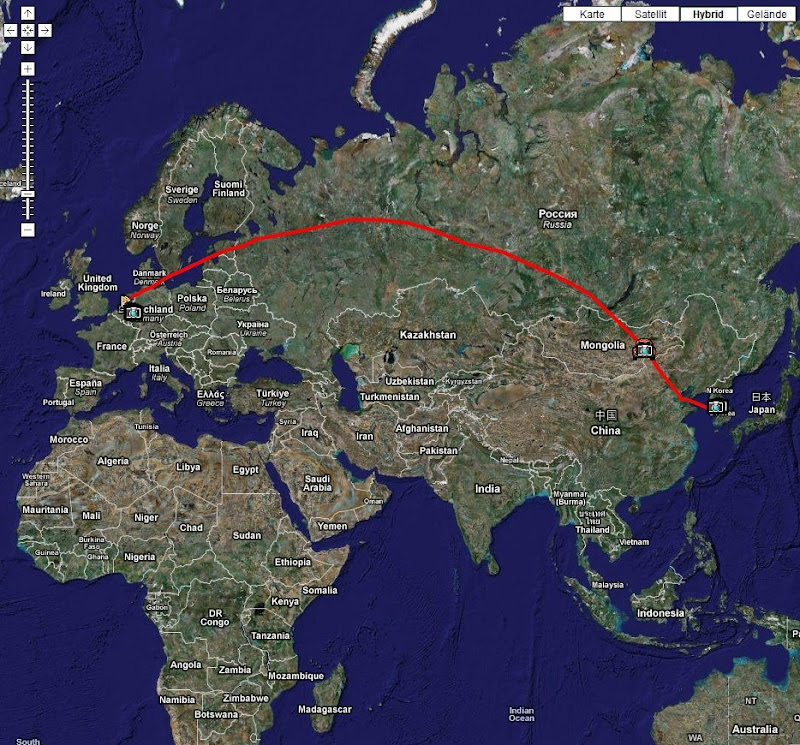
We got a new USB GPS tracker(from Mobile Action, GT100) and had to try it out on the trip to Korea. It worked very well compared to the other devices we had so far. It got the bus trip in Düsseldorf airport right and the entire flight from Amsterdam to Seoul. Tracking worked well in the taxi from the Airport to the hotel. While walking in downtown Seoul it still performed OK (given the urban canyons) with some outliers.

It did not get any signal while we were on the Fokker-50 from Düsseldorf to Amsterdam :-( I slept a few hours on the flight to Seoul but I think someone took a photo (probably of me) over Mongolia… If you wonder if it is allowed to used your GPS in the plane or not – it is – at least with KLM (according to a random website http://gpsinformation.net/airgps/airgps.htm :-)


Back in Korea, Adverts, Driving and Entertainment

On the way into town we got a really good price for the taxi (just make a mental note never to negotiate something with Florian and Alireza at the same time ;-) It seems taxi driving is sort of boring – he too watched television while driving (like the taxi driver some weeks ago in Amsterdam). I think we should seriously think more about entertainment for micro breaks because I still think it is for a good reason not allowed to watch TV while driving.

Seoul is an amazing place. There are many digital signs and electronic adverts. Walking back to the hotel I saw a large digital display on a rooftop (would guess about 10 meters by 6 meters). If working it is probably nice. But now it is mal functioning and the experience walking down the road is worsened as one inevitably looks at it. I wonder if in 10 years we will be used to broken large screen displays…   

Tuesday, 16 September 2008

What can you alarm clock do? Platform for the bedside table

I have learned about Chumby an interesting platform that is designed to replace devices on your bedside table. Looking forward to get one or some when I fly next time to the US.

For a design competion at the appliance design conference I did a design concept for a networked alarm clock [1] assuming that networked device will be soon cheaply available. Maybe we should look at the paper again and think about how to push such ideas forward as the devices are on the market…

[1] Schmidt, A. 2006. Network alarm clock (The 3AD International Design Competition). Personal Ubiquitous Computing Journal. 10, 2-3 (Jan. 2006), 191-192. DOI= http://dx.doi.org/10.1007/s00779-005-0022-y

Sunday, 14 September 2008

Buying Music Online – how easy is it?

Imagine there is a song – you know band and title – and you want to buy it. Should not be really something worthwhile reporting in a blog…

How long does it take to buy a song and how many steps does it need? I tried myself and was pretty much amazed that it is still more difficult than other ways to get music. The idea was to put the song into my shopping cart, press check-out, pay by credit card, and download. On the stores I encountered you have to register before to buy… I finally got the song and here are the steps at a major German music store: go to shop page, search for song, put in shopping cart, go to checkout, told to register, fill in registration form, told to confirm email, opened email client, waited 3 minutes for email, confirmed email, logged in on webpage, realized shopping card is empty :-(, search for song, put in shopping cart, go to checkout, entered credit card information, pay about 1.69€, got download link, got music.

I really wonder how many people will become first time buyers in this shop. Sometimes I think the things we teach in User Interface Engineering are obvious – but real life tells me they are not! If you run a music download portal or if you are in the music business and you wonder why no-one buys – we can tell you :-) it may be about utility and usability of your online offers… if you need more details we are happy to help you :-)

PS: there was a store with a .ru address with better usability that offered the song with no registration at 0.20€ - but I did not want to give my credit card details… 

Friday, 12 September 2008

Workshops at Informatik 2008 in Munich, e-ink prediction

Yesterday there was a workshop on Mobile and Embedded Interaction as part of Informatik2008 in Munich. The talks and discussions were very interesting. Lucia and Thomas raised interesting issues on a new notion of personal computing, where the mobile device becomes the center of a personal computing infrastructure. This idea has been around for some time (e.g. Roy Wants Personal Server [1]) but the new ideas and the feasibility with current hardware makes it really an exciting topic. On the general topic there are many open questions, as visible on the slide.

After the workshop, when swapping business cards, we started the discussion when in the future we will have business cards (in larger quantities, to give away) that have active display elements (e.g. eInk) included. Everyone gave a predictions in how many years we will have it (Lucia Terrenghi:never; Raimund Dachselt:7; Thomas Lang: business card will disappear; Albrecht Schmidt:9; Heiko Drewes:10; Florian Echtler:5; Michael Rohs:5; Paul Holleis:5). Lets get back in 5 years and see… In September 2008 the Esquire Magazine featured an e-ink cover page - have not seen it myself:-( but there is a video: http://www.esquire.com/the-side/video/e-ink-cover-video

Today we organized a workshop on Software, Services and Platforms for new infrastructures in telecommunication. We had a set of really interesting talks. As I did my PhD on context-awareness I was quite impressed by work on context oriented programming and the advances over the last years in this domain (good starting point on the topic with some publications [2]).

At the end of the workshop I gave the following scenario as an impulse for discussion: image there are 10 million facebook users that contniouly stream the video of what they see into the net, e.g. using eagle-i. The discussion raise many technical as well as social challenges!

[1] Want, R., Pering, T., Danneels, G., Kumar, M., Sundar, M., and Light, J. 2002. The Personal Server: Changing the Way We Think about Ubiquitous Computing. In Proceedings of the 4th international Conference on Ubiquitous Computing (Göteborg, Sweden, September 29 - October 01, 2002). G. Borriello and L. E. Holmquist, Eds. Lecture Notes In Computer Science, vol. 2498. Springer-Verlag, London, 194-209.

[2] http://www.swa.hpi.uni-potsdam.de/cop/

PS: there are few photos as someone in the workshop today objected to be on the net…

Tuesday, 9 September 2008

Workshop on Automobile User Interfaces

For the second time we ran this year a workshop on automobile user interfaces and interactive applications in the car at the German HCI conference: http://automotive.ubisys.org/

In the first session we discussed the use of tactile output and haptics in automotive user interfaces. It appears that there is significant interest in this area at the moment. In particular using haptics as an additional modality creates a lot of opportunities for new interfaces. We had a short discussion about two directions in haptic output: naturalistic haptic output (e.g. line assist that feels like going over the side of the road) vs. generic haptic output (e.g. giving a vibration cue when to turn).

 I think the first domain could make an interesting project – how does it naturally feel to drive too fast, to turn the wrong way, to be too close to the car in front of you, etc…

In a further session we discussed framework and concepts for in-car user interfaces. The discussion on the use of context with the interface was very diverse. Some people argued it should be only used in non-critical/optional parts of the UI (e.g. entertainment) as one is not 100% sure if the recognized context is right. Others argue that context may provide a central advantage, especially in safety critical systems, as it gives the opportunity to react faster. 

In the end it comes always down to the question: to what extent do we want to have the human in the loop… But looking at Wolfgang's overview slide it is impressive how much functionality depends already now on context...

In the third session we discussed tools and methods for developing and evaluating user interfaces in the car context. Dagmar presented our first version of CARS (a simple driving simulator for evaluation of UIs) and discussed findings from initial studies [1]. The simulator is based on the JMonkey Game engine and available open source on our website [2].

There were several interesting ideas on what topics are really hot in automotive UIs, ranging from interfaces for information gather in Car-2-Car / Car-2-Envrionment communication to micro-entertainment while driving.

[1] Dagmar Kern, Marco Müller, Stefan Schneegaß, Lukasz Wolejko-Wolejszo, Albrecht Schmidt. CARS – Configurable Automotive Research Simulator. Automotive User Interfaces and Interactive Applications – AUIIA 08. Workshop at Mensch und Computer 2008 Lübeck 2008

[2] https://www.pcuie.uni-due.de/projectwiki/index.php/CARS

PS: In a taxi in Amsterdam the driver had a DVD running while driving – and I am sure this is not a form of entertainment that works well (it is neither fun to watch, nor is it save or legal).

We presented MirrorBoard at Mensch und Computer 2008 in Lübeck

Last winter term I was teaching a class on Unconventional User Interfaces at the University of Linz as part of the MSc in Pervasive Computing. As part of the exercises the students had to do a project and write a paper on the topic in a group. This required to do a full round in the development (from idea creation to study).

Florian König and his group had an exciting idea for a novel form of advertisement. The user is mirrored in the advert and becomes a part of it. They implemented an interactive poster for a travel agent (users become part of the holyday scene) and tested it in-situ. The paper was accepted at the German HCI conference (Mensch und Computer) and Florian presented it today very well [1].

In the questions there was much discussion about privacy and user acceptance. We discussed whether or not such a installation would be legal in Germany (people mentioned the Datenschutzgesetz §6).

[1] Johannes Schönböck, Florian König, Gabriele Kotsis, Dominik Gruber, Emre Zaim, Albrecht Schmidt. MirrorBoard – An Interactive Billboard. Mensch und Computer 2008. Lübeck. Oldenbourg Verlag, 2008, p 207-216.

Monday, 8 September 2008

Is there a Net Generation? Keynote by Rolf Schulmeister

This year the German HCI conference (Mensch und Computer) is co-located with the German e-learning conference. The opening keynote this morning by Rolf Schulmeister was an interesting analysis of how young people use media in the context of learning. Over the last year that have been plenty of popular science books that tell us how human kind changes with the internet, e.g. Digital Native vs. Digital Immigrands by Marc Prensky (extract). The talk seriously questioned if a “Net Generation” exists and it seems that many of the properties associated with it (e.g. short attention spans, use of internet to socialize, reveal feelings through the internet, preference of graphics over text) are found based on studies where people select themselves to participate in the studies/questionnaires.

The paper (Gibt es eine »Net Generation«, in German over 130 pages) that accompanies the talk provides many interesting reference and is worthwhile a further look.

Saturday, 6 September 2008

Some random papers from Mobile HCI 2008

During mobile HCI I came across many interesting things (that is why one goes to conferences ;-) here is a selection of papers to look at – if you have more time it is worthwhile to look at the whole proceedings of mobile HCI 2008 in the ACM DL.

Gauntlet: a wearable interface for ubiquitous gaming – exploring a new gaming UI for gestures.

Mobile phones as artifacts children use in their games are discussed. Shows again how creative children are ;-)

An Investigation into round touch screen Wristwatch interaction – interesting topic and good example how to do a small study. Ideas to create a tactile rim, e.g. 2 parts moving to have different tactile cues, were brought up in the discussion.

Programming with children – taking programming it into the environment away from the computer, relates to Tangible User Interfaces

Projector phone: a study of using mobile phones with integrated projector for interaction with maps

Interaction based on Speech seems possible – even in noisy environment – the paper reports interesting preliminary results in the context of a fishing boot. Interesting in-situ tests (e.g. platform in a wave tank)

Wearable computing user interfaces. Where should we put the controls and what functions do uses expect?

Learning-oriented vehicle navigation systems: a preliminary investigation in a driving simulator

Enrico Rukzio followed up the work from Munich pushing the idea of touch interaction with NFC devices further.

Color matching using a mobile phone. The idea is to use a color chart, take a photo of face with a color chart, sent by mms to server, server process look up color match, reply by sms; no software installation only using MMS, SMS. Application in cosmetics are discussed.

Using Second Life to demonstrate a concept automobile heads up display (A-HUD)

Friday, 5 September 2008

Paul Holleis presented our paper on Wearable Controls

Last year Paul did an internship a Nokia in Finland. He worked there on the integration of capacitive sensors in phones and clothing. After Paul was back we jointly followed up on the topic which resulted in an interesting set of guidelines for placing wearable controls [1].

The paper gives a good overview of wearable computing and interaction with wearable computers. In the work we focused on integrating touch sensitive controls into garments and accessories for a operating the music player integrated in a phone. The study showed that there are prime locations where to place controls on their body: the right hip and above the right knee (for more details see the paper [1]). It furthermore showed that it is not clear expectations of functions (e.g. forward, backward, volume up/down) with regard to controls laid out on the close.

During his internship he also did research on integrating touch into buttons, which was published at Tangible and Embedded Interaction 2008 [2].

[1] Holleis, P., Schmidt, A., Paasovaara, S., Puikkonen, A., and Häkkilä, J. 2008. Evaluating capacitive touch input on clothes. In Proceedings of the 10th international Conference on Human Computer interaction with Mobile Devices and Services (Amsterdam, The Netherlands, September 02 - 05, 2008). MobileHCI '08. ACM, New York, NY, 81-90. DOI= http://doi.acm.org/10.1145/1409240.1409250

[2] Paul Holleis, Jonna Häkkilä, Jussi Huhtala. Studying Applications for Touch-Enabled Mobile Phone Keypads. Proceedings of the 2nd Tangible and Embedded Interaction Conference TEI’08. February 2008.

Thursday, 4 September 2008

Andrew Greaves presents a study on photo browsing using projector phones

Since Enrico Rukzio (my first PhD student) went to Lancaster he discovered and advanced a very exciting topic for mobile interaction: mobile projector/projector phones. His group has a great presencs at this year’s mobile HCI (3 demonstrations, 2 short papers, 2 full papers, a workshop). In time for the conference the first projector phone appeared on the market (Cking Epoq EGP-PP01) - as to highlight the timeliness of the work.

The mobile projector study [1] revealed several interesting aspects. 1) it is faster to browser on the phone screen than using a project, 2) users do a lot of context switches between projection and device – even nothing is displayed on the screen, 3) the users see a great value in it (even if they may be slower). I am really looking forward to further results in this area. It may be significantly change the way we use mobile phones!

PS: see Enrico watching his student present I remember how exciting it is for a supervisor to just watch…

[1] Andrew Greaves, Enrico Rukzio. Evaluation of Picture Browsing using a Projector Phone. 10th International Conference on Human-Computer Interaction with Mobile Devices and Services (Mobile HCI 2008). Amsterdam, Netherlands. 2-5 September 2008.

Wednesday, 3 September 2008

Survey on mobile shopping experience

I recently discussed with Felix von Reischach (from the group of Florian Michahelles at the autoidlabs/ETH Zürich) ideas for a survey and study in the domain of mobile shopping.

He put together a survey – please have a look and take part!

Sightseeing, Photos

After the conference reception and dinner we went around Amsterdam for some late night sightseeing. Amsterdam is an amazing place...

On the tram back Florian made some very interesting pictures - this is not Photoshop ;-) it is a reflection in the window!

Implanted Persuasion Technologies

While listening to BJ Fogg, and especially on the motivation pairs (in particular instant pleasure and gratification vs. instant pain) I was wondering how long it will take till we talk about and see implantable persuasion technologies. Take the example of obesity – here one could really image ways of creating an implant that provides motivation for a certain eating behavior… would this be ethical?

Keynote at MobileHCI2008: BJ Fogg - mobile miracle

BJ Fogg gave the opening keynote at mobile HCI 2008 in Amsterdam. The talk explained very well the concept of Captology (computers as persuasive technologies) and the newer projects are very inspiring. He put the following questions at the center: How can machines change people’s minds and hearts? How can you automate persuasion? His current focus is on behavior change.

He reported of a class he is teaching at Stanford on designing facebook applications. The metric for success (and on this students are marked) is the uptake of the created application over the time of the course. He reported that the course attracted 16 million users in total and about 1 million on a daily basis – that is quite impressive. This is also an example of the approach he advocates: “rather try than think”. The rational is to try out a lot of things (in the real market with real users, alpha/beta culture) rather than optimize a single idea. Here the background is that nowadays implementation and distribution is really easy and that the marked decides if it is hot or not… His advice is to create minimal application – simple application and then push it forward. All big players (e.g. google, flickr) have done it this ways…

With regard to the distribution methods for persuasion he referred over and over to social networks (and in particular facebook). His argument is that by these means one is able to reach many people in a trusted way. He compared this to the introduction of radio but highlighted the additional qualities. Overall he feels that Web 2.0 is only a worm up for all the applications to come on the mobile in the future.

At the center of the talk was that prediction that mobile devices will be within 15 years the main technology for persuasion. He argued that mobile phones are the greatest invention of human kind – more important than the writing and transportation systems (e.g. planes, cars). He explained why mobile phones are so interesting based on three metaphors: heart, wrist watch, magic wand.

Heart – we love our mobile phones. He argued that if users do not have their phone with them they miss it and that this is true love. Users form a very close relationship with their phone and spend more time with the phone than with anything/anyone else. He used the image of “mobile marriage”…

Wrist watch – the phone is always by our sides. It is part of the overall experience in the real world provding 3 functions: Concierge (reactive, can be asked for advice, relationship base on trust), Coach (proactive, coach comes to me tells me, pushing advice), and Court Jester (entertains us, be amused by it, create fun with content that persuades).

Magic wand – phones have amazing and magical capabilities. A phone provides humans with a lot of capabilities (remote communication, coordination, information access) that empower many things.

Given this very special relationship it may be a supplement for our decision making (or more general our brain). The phone will advise us what to do (e.g. navigation systems tell us where to go) and we love it. We may have this in other areas, too – getting told what movie to see, what food to eat, when to do exercise, … not fully convinced ;-)

He gave a very interesting suggestion how to design good mobile applications. Basically to create a mobile application the steps are: (1) Identify the essence of the application, (2) strip everything of the application that is not essential to provide this and (3) you have a potentially compelling mobile application. Have heard of this before, nevertheless it seems that still features sell but it could by a change with the next generation.

He provided some background on the basics of persuasion. For achieving a certain target behavior you need 3 things – and all at the same time: 1. sufficient motivation (they need to want to do it), 2. Ability to do what they want (you either have to train them or to make it very easy – making easer is better) and 3. a trigger. After the session someone pointed out that this is similar to what you have in crime (means, motive, opportunity ;-)

For creating persuasive technologies there are 3 central pairs describing motivation:

  • Instant pleasure and gratification vs. instant pain
  • Anticipation of good or hope vs. anticipation of the bad or fear (it is noted that hope is the most important motivator
  • Social acceptance vs. social rejection

When designing systems it is essential to go for simplicity. He named the following five factors that influence simplicity: (1) money, (2) physical effort, (3) brain cycles, (4) social deviation, and (5) non-routine. Antonio pointed out that this links to work of Gerd Gigerenzer at MPI work on intuitive intelligence.

[1] Gigerenzer, G. Gut feelings: The intelligence of the unconscious. New York: Viking Press.

Google chrome, secrets, the power of search engines

Lots of people downloaded Google chrome during the conference. And it seemed that google managed to keep secret till the date it is launched – they managed that before with other released… given the quality of the software that seems realy hard - or not?

How does google manage to keep its developments secret? One random though is: keeping a secret is much easier if you have control over everyone's search engine and can decided what shows up and what not…

Just thinking of this it shows again the power the search engine company has over the user… Perhaps I should again get used to searching regularly with different search engines (e.g. http://www.cuil.com/ crawls and have their own index). Perhaps there could be a small project to create a search site that combines results from different sources (... hostory repeats... metasearch engines were popular in the 90s before altavista came along).

PS: seems that the new browser works reasonably fast and rendering is OK.

Tuesday, 2 September 2008

MobileHCI 2008 Tutorial

The conference on mobile human computer interaction (MobileHCI 2008) started today in Amsterdam with the tutorial and workshop day.

I am chairing the tutorials and we tried a new approach for the tutorial, having 6 sessions/chapters that all together make up an introduction to mobile HCI. After 10 years of mobile HCI it seems important to help new members of the community to quickly learn about the field. The presentations were given by experts in the field that had 1 hour each for their topics. We had unexpected high attendence (the room with 100 seats was nearly always full). Have a look at the slides:

Text input for mobile devices by Scott MacKenzie
Scott gave an overview of different input means (e.g. key-based, stylus, predictive, virtual keyboard), parameters relevant for designing and assessing mobile text input (e.g., writing speed, cognitive load) and issues related to the context of use (e.g., walking/standing).

Mobile GUIs and Mobile Visualization by Patrick Baudisch

Patrick introduced input and output options for mobile devices. He will talk about the design process, prototyping and assessment of user interfaces, trade-offs related to the design of mobile GUIs and different possible interaction styles.

Understanding Mobile User Experience by Mirjana Spasojevic
Mirjana discussed different means for studying mobile user needs and evaluating the user experience. This includes explorative studies and formal evaluations (in the lab vs. in the field), including longitudinal pilot deployments. The lecture discusses traditional HCI methods of user research and how they need to be adapted for different mobile contexts and products.

Context-Aware Communication and Interaction by Albrecht Schmidt
Albrecht gave an overview of work in context-awareness and activity recognition that is related to mobile HCI. He discussed how sharing of context in communication applications can improve the user experience. The lecture explained how perception and sensing can be used to acquire context and activity information and show examples how such information can be exploited.

Haptics, audio output and sensor input in mobile HCI by Stephen Brewster
Stephen discussed the design space for haptics, audio output as well as sensor and gesture input in mobile HCI. Furthermore he assessed resulting interaction methods and implications for the interactive experience.

Camera-based interaction and interaction with public displays by Michael Rohs
Michael introduced camera based interaction with mobile devices; this included a assessment of optical markers, 2D-barcodes and optical flow as well as techniques related to augmented reality. In this context he addressed interaction with public displays, too.

You can also download the complete tutorial including all 6 chapters in a single PDF file (16MB).

Sunday, 31 August 2008

How to keep up with all the developments in mobile communication?

Recently I get this question more often - especially how to keep up with developments outside the scientific community. Some tell this is not important if you do research, however to me the actual uses are a very important inspirations.

There is no single source but an interesting address in the WWW is textually.org – it is very international and covers much more than technology!

Thursday, 28 August 2008

Workshop on User Experience at Nokia

Together with Jonna Hakkila’s group (currently run by Jani Mantyjarvi) we had a two day workshop at Nokia in Oulu discussion the next big thing* ;-)
* motto on the Nokia research centers web page

It seems that many people share the observation that emotions and culture play a more and more important role in the design of services and applications – even outside the research labs. One evening we looked for the Finnish experience… (photo by Paul)

Overall the workshop showed again how many ideas can be created in a very short time – hopefully we can follow up some of them and create some new means for communication. We plan to meet again towards the end of the year in Essen.

PS: Kiss the phone – some take it literarily: http://tech.uk.msn.com/news/article.aspx?cp-documentid=7770403

PPS: we talked about unanticipated use (some call it misuse) of technology, e.g. using the camera on the phone to take a picture of the inside of your fridge instead of writing a shopping list. Alternative uses is not restricted to mobile phones - see for yourself what you dishwasher may be good for.... http://www.salon.com/nov96/salmon961118.html

Tuesday, 26 August 2008

HCI Doctoral Consortium at VTT Oulu

Jonna Hakkila (Nokia), Jani Mantyjarvi (Nokia & VTT), and I discussed last year how we can improve the doctoral studies of our students and we decided to organize a small workshop to discuss PhD topics.

As Jonna is currently on maternity leave and officially not working we ran the workshop at VTT in Oulu.

The topics varied widely from basic user experience to user interface related security. There was very interesting work the participants did and published. I have selected the following 2 as reading suggestions: [1] by Elina Vartiainen and [2] by Anne Kaikkonen.

We hope we gave some advise – can resist to repeat the most important thing to remember:

  • a PhD thesis is not require to solve all problems in a domain
  • doing a PhD is yet another exam – not more and not less
  • finding/inventing/unterstanding something that makes a real difference to even a small part of the world is a great achievement (an not common in most PhD research)
  • do not start with thinking hard - start with doing your research

A good discussion on doing a PhD in computer science by Jakob Bardram can be found at [3].

[1] Roto, V., Popescu, A., Koivisto, A., and Vartiainen, E. 2006. Minimap: a web page visualization method for mobile phones. In Proceedings of the SIGCHI Conference on Human Factors in Computing Systems (Montréal, Québec, Canada, April 22 - 27, 2006). CHI '06. ACM, New York, NY, 35-44. DOI= http://doi.acm.org/10.1145/1124772.1124779

[2] Lehikoinen, J. T. and Kaikkonen, A. 2006. PePe field study: constructing meanings for locations in the context of mobile presence. In Proceedings of the 8th Conference on Human-Computer interaction with Mobile Devices and Services (Helsinki, Finland, September 12 - 15, 2006). MobileHCI '06, vol. 159. ACM, New York, NY, 53-60. DOI= http://doi.acm.org/10.1145/1152215.1152228

[3] http://www.itu.dk/people/bardram/pmwiki/pmwiki.php?n=Main.ArtPhD

Thursday, 7 August 2008

Christian Kray visits our Lab

Christian Kray and I were colleagues in Lancaster for a very short time – he just joined the university when I left for Munich. After his post-doc in Lancaster he moved to a position in Newcastle.

His work at the cross roads of mobile interaction and public displays is very exciting. In particular he investigates interesting concepts related to visual codes – some aspects to these ideas are discussed in “Swiss Army Knife meets Camera Phone” [1]. His new prototypes are really cool and I look forward to see/read more about them.

We realized that there are many areas where we have common interests. Perhaps there is a chance in the future to work together on some of the ideas discussed!

[1] Swiss Army Knife meets Camera Phone: Tool Selection and Interaction using Visual Markers. C. Kray and M. Rohs. (2007) In "Workshop on Mobile Interaction with the Real World at Mobile HCI 2007". Singapore, September 9, 2007.

Wednesday, 6 August 2008

Matthias Kranz defended his PhD

Today Matthias Kranz defended his PhD thesis „Engineering Perceptive User Interfaces“ successfully at the University of Munich! Congratulations… and remember "Training to become a Jedi is not an easy challenge. And even if you succeed, it's a hard life." (Qui-Gon Jinn, Star Wars Episode I: The Phantom Menace)

After Enrico Rukzio Matthias is the second of my PhD students who worked with me in Munich to finish. He is now with the German Aerospace center (DLR).

Matthias worked on the DFG project “Embedded Interaction” and has created and published an impressive set of prototypes and studies in pervasive computing over the last 4 years. See his homepage for details. If you only have time to read 2 pages – here is my suggestion: Context-aware kitchen utilities [1].

The personalized doctoral hat is a German tradition –and Matthias got a fully functional prototype of a perceptive doctoral hat (following the modification and restriction approach suggested in his thesis, but created without end-user involvement to keep the surprise ;-)

Insider hint: http://en.wikipedia.org/wiki/Microfilm - just don’t!


[1] Kranz, M., Schmidt, A., Maldonado, A., Rusu, R. B., Beetz, M., Hörnler, B., and Rigoll, G. 2007. Context-aware kitchen utilities. In Proceedings of the 1st international Conference on Tangible and Embedded interaction (Baton Rouge, Louisiana, February 15 - 17, 2007). TEI '07. ACM, New York, NY, 213-214. DOI= http://doi.acm.org/10.1145/1226969.1227013

Monday, 4 August 2008

Nicolas Villar visiting

Nicolas, who was the first BSc student I worked with in Lancaster, is now after finishing his PhD with Microsoft Research in Cambridge, UK. He came on Friday to Essen to see the lab and he brought us a Voodoo I/O box [1] – we are really excited!

He stayed for the weekend and I learned a lot about interesting technologies and ideas. Looking at his iREX ebook and Vivien's new USB Microscope (30€ from Aldi ;-) we had to do some research into the screen quality of different devices. It is interesting to see that e-Ink moves closer to newspaper and that in comparison to it an iPhone screen is pretty coarse.

Some references to remember:

[1] Spiessl, W., Villar, N., Gellersen, H., and Schmidt, A. 2007. VoodooFlash: authoring across physical and digital form. In Proceedings of the 1st international Conference on Tangible and Embedded interaction (Baton Rouge, Louisiana, February 15 - 17, 2007). TEI '07. ACM, New York, NY, 97-100. DOI= http://doi.acm.org/10.1145/1226969.1226989

Sunday, 27 July 2008

Emmy Noether Meeting in Postdam

From Friday to Sunday I was in Potsdam for the yearly Emmy Noether meeting organized by DFG (German Science Foundation). The Emmy Noether Program seems to me one of the most attractive funding options for early career researchers I know of (world wide).

This year I was in the preparation team for the meeting and was co-organizing one workshop where we discussed experiences with research funding in other countries and what ideas for improving current programs we can see. The workshop was on how we can benefit from having students rather than seeing them as “teaching load” – especially in computer science (I organized it with Andreas Butz).

The meeting is always very interesting as it brings together people, funded by DFG in the Emmy Noether Program, across all disciplines. In the political evening we had a keynote by Professor Hans Weiler looking at the current problems of the German systems ("Eliten im Wettbewerb - Die deutschen Hochschulen und die internationale Konkurrenz" ) – one message I saw in the talk is that Germany is very efficient – looking how little money is spend in education and research the outcome is surprising. (But this is only a positive message if we do not want to play a leading role in the world of science and technology). It became very clear that the overall system lacks massively in funding. The additional funding that is provided by the German Government in the widely publicized call for elite universities (Exzellenzinitiative) is 1900 million Euros over 5 years (about 5€/citizen/year)– impressive? Not really – this less than the amount projected for the “Yale Tomorrow” campaign – a 5 year program in fundraising by a single University in the US. And Stanford University has even a bigger campaign as Prof. Weiler told – and there are a few other Universities in the league in the US...

Wednesday, 16 July 2008

GPS monitoring for car insurance

In my talk at ISUVR2008 I referred to an example where an insurance is monitor driving behavior and makes a tariff according to this. Some people asked me for more details and
references, here they are…

My example was based on the pilot announced from the German insurance WGV. They planned to run a pilot with 1500 people using a GPS based monitoring devices. The box is mounted in the car and compares the current speed with the allowed speed limit and warns to reduce speed (if over the limit). If the driver is more than 12 times per year over the speed limit (basically ignoring the warning) he does not get the reduced rate. (see http://www.wgv-online.de/docs/youngandsafe.pdf - in German only). In the announcement it said they will run the pilot to 2009...

There are different ideas how to take GPS driving monitoring beyond the lab, e.g. in 2007 Royal & SunAlliance announced a GPS-based eco car insurance and the AIG a Teen GPS Program – targeted at parents.

Looking at different comments (on news pages and in blogs) it seems that people's opinions are very split...

Sunday, 13 July 2008

Thermo-imaging camera at the border – useful for Context-Awareness?

When we re-entered South Korea I saw guard looking with an infrared camera at all arriving people. It was very hot outside so the heads were very red. My assumption is that this is used to spot people who have fever – however I could not verify this.

Looking at the images created while people moved around I realized that for many tasks in activity recognition, home health care, and wellness this may be an interesting technology to use. For several tasks in context-awareness it seems straightforward to get this information from an infrared camera. In the computer vision domain it seems that there have several papers towards this problem over the recent years.

We could thing of an interesting project topic related to infrared activity recognition or interaction to be integrated in our new lab… There are probably some fairly cheep thermo-sensing cameras around to used in research – for home brew use you find hints on the internet, e.g. How to turn a digital camera into an IR cam – pretty similar to what we did with the web cams for our multi-touch table.

The photo is from http://en.wikipedia.org/wiki/Thermography

Trip to North Korea

[see the whole set of photos from tour to North Korea]

From Gwangju we took the bus shortly after midnight to go for a trip to North Korea. The students did a great job in organizing ISUVR and the trip. It was great to have again some time to talk to Yoosoo Oh, who was a visiting researcher in Munich in our group.

When entering North Korea there are many rules, including that you are not allowed to take cameras with tele-lenses over 160mm (so I had to take only the 50mm lens) and you must not bring mobile phones and mp3 players with you. Currently cameras, phones and MP3 players are visible with the human eye and to detect in an x-ray. But it does not take much imagination to see in a few years extremely small devices that are close to impossible to spot. I wonder how this will change such security precautions and whether or not I will in 10 years still possible to isolate a country from access to information. I doubt it…

The sightseeing was magnificent – see the photos of the tour for yourself. We went onto the Kaesong tour (see http://www.ikaesong.com/ - in Korea only) It is hard to tell how much of the real North Korea we really saw. And the photos only reflect a positive selection of motives (leaving out soldiers, people in town, ordinary buildings, etc. as it is explicitly forbidden to take photos of those). I was really surprise when leaving the country they check ALL the pictures you took (in my case it took a little longer as it was 350 photos).

The towns and villages are completely different from what I have seen so far. No cars (besides police/emergency services/army/tourist busses) – but many people in the street walking or cycling. There were some buses in a yard but I have not seen public transport in operation. It seemed the convoy of 14 tourist buses is an attraction to the local people…

I have learned that the first metal movable type is from Korea – about 200 years before Gutenberg. Such a metal type is exhibited in North Korea and in the display is a magnifying glass in front of the letter – pretty hard to take a picture of…

Saturday, 12 July 2008

ISUVR 2008, program day2

Norbert Streitz – Trade-off for creating smartness

Norbert gave an interesting overview of research in the domain of ubicomp based on his personal experience – from Xerox PARC to the disappearing computer. He motivated the transition from Information Design to Experience Design. Throughout the work we see a trade-off between providing “smart support” to the user and “privacy” (or control over privacy). One of the questions if we will re-invent privacy or if it will become a commodity…

As one of the concrete examples Norbert introduced the Hello.Wall done in the context Ambient Agoras [1]. This again brought up the discussion of public vs. private with regard to the patterns that are displays. (photos of some slides from Norbert's talk)

[1] Prante, T., Stenzel, R., Röcker, C., Streitz, N., and Magerkurth, C. 2004. Ambient agoras: InfoRiver, SIAM, Hello.Wall. In CHI '04 Extended Abstracts on Human Factors in Computing Systems (Vienna, Austria, April 24 - 29, 2004). CHI '04. ACM, New York, NY, 763-764. DOI= http://doi.acm.org/10.1145/985921.985924 (Video Hello.Wall)


Albrecht Schmidt – Magic Beyond the Screen

I gave a talk on “Human Interaction in Ubicomp -Magic beyond the screen” highlighting work in user interfaces beyond the screen that we did over the last years. It is motivated by the facts that classical limitations in computer science (e.g. frame rate, processing, storage) are getting less and less important to many application areas and that the human computer interaction becomes in many areas the critical part of the system.

In my talk I suggested using “user illusion” as a design tool for user interfaces beyond the desktop. This involves two steps: 1) describe precisely the user illusion the application will create and the 2) Investigate what parameters have an influence on the quality of the created user illusion for the application. (photos of some slides from Albrecht's talk, Slides in PDF)


Jonathan Gratch – Agents with Emotions

His talk focused on the domain of virtual reality with a focus on learning/training applications. One central thing I learned is that the timing of non-verbal cues (e.g. nodding) is very crucial to produce an engagement in speaking with an agent. This may also be interesting for other forms of computer created feedback.
He gave a specific example on how assigning blame works. It was really interesting to see that there are solid theories in this domain that can be concretely used to design novel interfaces. He argues that appraisal theory can explain people’s emotional states and this could improve context-awareness.

He showed an example of emotional dynamics and it is amazing how fast emotion happen. One of the ways of explaining this is to look at different dynamics: dynamics in the world, dynamics in the perceived world relationship, and dynamic through action. (photos of some slides from Jonathan's talk)


Daijin Kim – Vision based human robot interaction
Motivated by the vision that after the personal computer we will see the “Personal Robot” Daijin investigates natural ways to interact with robots. For vision based interaction with robots he named a set of difficulties, in particular: people are moving, robots are moving, and the illuminations and distances are variable. The proposed approach is to generate a pose, expression, and illumination specific active appearance model.
He argues that face detection is a basic requirement for vision based human robot interaction. The examples he showed in demo movie were very robust with regard to movement, rotation, and expression and it works for very variable distances. The talk contained further examples of fast face recognition and recognition of simple head gestures. Related to our research it seems that such algorithms could be really interesting in creating context-aware outdoor advertisement. (photos of some slides from Daijin's talk)


Steven Feiner – AR for prototyping UIs
Steven showed some work mobile projector and mobile device interaction, were they used augmented reality for prototyping different interaction methods. He introduced Spot-light (position based interaction), orientation based interaction and widget-based interaction for an arm mounted projector. Using the synaptic touchpad and projection may also be an option for our car-ui related research. For interaction with a wrist device (e.g. a watch) he introduced the string-based interaction which is a simple but exciting idea. You pull out a string of a device and the distances as well as the direction are the resulting input parameters [2].

In a further example Steven showed a project that supports field work on identification of plants using capture (of the image of the real leaf), comparison with the data base and matching out of a subset that matches the features. Their prototype was done on a tablet and he showed ideas how to improve this with AR; it is very clear that this may also an interesting application (for the general user) on the mobile phone.

New interfaces and in particular gestures are hard to explore – if you have no idea what is supported by the system. In his example on visual hint for tangible gestures using AR Steven showed interesting options in this domain. One approach follows a “preview style” visualizations – they called it ghosting. (photos of some slides from Stevens's talk)

[2] Blasko, G., Narayanaswami, C., and Feiner, S. 2006. Prototyping retractable string-based interaction techniques for dual-display mobile devices. In Proceedings of the SIGCHI Conference on Human Factors in Computing Systems (Montréal, Québec, Canada, April 22 - 27, 2006). R. Grinter, T. Rodden, P. Aoki, E. Cutrell, R. Jeffries, and G. Olson, Eds. CHI '06. ACM, New York, NY, 369-372. DOI= http://doi.acm.org/10.1145/1124772.1124827

[3] White, S., Lister, L., and Feiner, S.Visual Hints for Tangible Gestures in Augmented Reality.Proc. ISMAR 2007 IEEE and ACM Int. Symp. on Mixed and Augmented Reality, Nara Japan, November 13-16, 2007. (youtube video)

If you are curious about the best papers, please the photos from the closing :-)

Finally some random things to remember:

  • Richard W. DeVaul did some work on subliminal user interfaces - working towwrds the vision of zero attention UIs [4]
  • Jacqueline Nadel (development psychologist) did studies on emotions between parents and infants using video conferencing
  • V2 - Toward a Universal Remote Console Standard http://myurc.org/whitepaper.php
  • iCat and Gaze [5]

[4] Richard W. DeVaul. The Memory Glasses: Wearable Computing for Just-in-Time Memory Support. PhD Thesis. MIT 2004. http://devaul.net/~rich/DeVaulDissertation.pdf

[5] Poel, M., Breemen, A.v., Nijholt, A., Heylen, D.K., & Meulemans, M. (2007). Gaze behavior, believability, likability and the iCat. Proceedings Sixth Workshop on Social Intelligence Design: CTIT Workshop Proceedings Series (pp. 109–124). http://www.vf.utwente.nl/~anijholt/artikelen/sid2007-1.pdf