Sunday, 17 April 2011
Floor for activity recognition
Some years back in 2002 (and looking at the photos and the amount of hair I still had this seems long ago) in Lancaster we also looked in what to do with floors (and we were into DIY as well). We also considered arrangements with a floor tables and furniture on top. As you can see from Kristof, Hans and me on the photo it was a fun project.
The positive point in using load sensing is that you can track unobtrusive and potentially large scales with little instrumentation. We even considered the possibility to put a house on 4 load cells and do activity recognition based on this. We never got around to building the house ;-) The problem with load sensing is that you can only track one moving object/subject at the time.
Looking at the signature of the load measured and doing some signal processing we could detect events – unobtrusive and cheap – but only for single events.
Interested in more details? Have a look at the publications on load sensing [1], on the interaction [2], and at a patent [3] describing the basic technology.
[1] Schmidt, A., Strohbach, M., Laerhoven, K. v., Friday, A., and Gellersen, H. 2002. Context Acquisition Based on Load Sensing. In Proceedings of the 4th international Conference on Ubiquitous Computing (Göteborg, Sweden, September 29 - October 01, 2002). Springer-LNCS, London, 333-350.
[2] Schmidt, A.; Strohbach, M.; van Laerhoven, K. & Hans-W., G. 2003. Ubiquitous Interaction - Using Surfaces in Everyday Environments as Pointing Devices, Universal Access Theoretical Perspectives, Practice, and Experience (UI4ALL 2003), Springer LNCS, 263-279.
[3] Schmidt, A., Strohbach, M., Van Laerhoven, K., Friday, A., Gellersen, H-W., Kubach, U.; Context acquisition based on load sensing. US Patent 7434459. US Patent Issued on October 14, SAP AG (DE), 2008
Thursday, 3 March 2011
Workshop: Context-aware QoS
The workshop is co-located with 20th International Conference on Computer Communications and Networks (ICCCN) 2011 from July 31 - August 4, 2011 at the Sheraton Hotel and Resort, Maui, Hawaii.
Monday, 20 September 2010
Interviewing with Rikke Friis Dam and Mads Søgaard

With their current work Rikke and Mads pursue a mission to create a new and free resource for teaching and learning interaction design and HCI. In a first step they work with researchers (like myself) around the world that are experts on a certain topic (in my case context-awareness and implicit interaction) to create new teaching materials. This includes a chapter (about 3000 words) that has tutorial character and interviews in which specific topics are discussed in more details.
It was great fun to work with them and I look forward to seeing the new material online.
Wednesday, 31 March 2010
Keynote by Pertti Huuskonen: Ten Views to Context Awareness
[1] Schmidt, A., Aidoo, K. A., Takaluoma, A., Tuomela, U., Laerhoven, K. V., and Velde, W. V. 1999. Advanced Interaction in Context. In Proceedings of the 1st international Symposium on Handheld and Ubiquitous Computing (Karlsruhe, Germany, September 27 - 29, 1999). H. Gellersen, Ed. Lecture Notes In Computer Science, vol. 1707. Springer-Verlag, London, 89-101.
Tuesday, 2 March 2010
Sensor modules for acceleration, gyro, and magnetic field
- LSM303DLH - 3-axis accelerometer and 3-axis magnetometer in a single chip
- L3G4200D - low-power yaw, pitch and roll digital gyroscope
Last week in Finland I met Antii Takaluoma (one of the co-authors of [1]) and he works now for offcode.fi - I saw impressive Linux hardware - I expect cool stuff to come :-)
[1] Schmidt, A., Aidoo, K. A., Takaluoma, A., Tuomela, U., Laerhoven, K. V., and Velde, W. V. 1999. Advanced Interaction in Context. In Proceedings of the 1st international Symposium on Handheld and Ubiquitous Computing (Karlsruhe, Germany, September 27 - 29, 1999). H. Gellersen, Ed. Lecture Notes In Computer Science, vol. 1707. Springer-Verlag, London, 89-101.
[2] Hinckley, K., Pierce, J., Sinclair, M., and Horvitz, E. 2000. Sensing techniques for mobile interaction. In Proceedings of the 13th Annual ACM Symposium on User interface Software and Technology (San Diego, California, United States, November 06 - 08, 2000). UIST '00. ACM, New York, NY, 91-100. DOI= http://doi.acm.org/10.1145/354401.354417
[3] Albrecht Schmidt. Implicit human computer interaction through context. Personal and Ubiquitous Computing, 4(2):191-199, June 2000
[4] A. Schmidt and K. Van Laerhoven. How to Build Smart Appliances?, IEEE Personal Communications, p.66 - 71, (2001)
Tuesday, 15 September 2009
Workshop at MobileHCI: Context-Aware Mobile Media and Mobile Social Networks
The topic came up in discussions some time last year. It is very clear that social network have moved towards mobile scenarios and that utilizing context and contextual media adds a new dimension. The workshop program is very diverse and ranges studying usage practices to novel technological solutions for contextual media and application.One topic that is interesting to further look at is to use (digital) social networks for health care. Taking an analogy in history it is evident that the direct social group you were in took were the set of people that helped you in case of illness or accident. Looking at conditions and illnesses that cause a loss of mobility or memory it could be interesting to find applications on top of digital social networks to provide help. Seems this could be a project topic.
In one discussion we explored what would happen if we would change our default communication behavior from closed/secret (e.g. Email and SMS) to public (e.g. bulletin boards). I took the example of organizing this workshop: our communication has been largely on email and has not been public. If it would had been open (e.g. public forum) we probably would have organized the workshop in the same way but at the same time provided an example how one can organize a workshop and by this perhaps provided useful information for future workshop chairs. In this case there are little privacy concerns but images all communication is public? We would learn a lot about how the world works…About 10 years ago we published at paper there is more to context than location [1]. However, looking at our workshop it seems: location is still the dominant context people think of. Many of the presentations and discussions included the term context, but the examples focused on location. Perhaps we do need location only? Or perhaps we should look more closely to find the benefit of other contexts?
[1] A. Schmidt, M. Beigl, H.W. Gellersen (1999) There is more to context than location, Computers & Graphics, vol. 23, no. 6, pp. 893-901.
Saturday, 20 December 2008
New project on ambient visualization - kick-off meeting in Munich
Related to this there is a large and very interesting project: IYOUIT. Besides other things it can record and share your context – if you have a Nokia series 60 phone you should try it out. As far as I remember it was voted best mobile experience at mobile HCI 2008.
Wednesday, 24 September 2008
My Random Papers Selection from Ubicomp 2008
Don Patterson presented a survey on using IM. One of the finding surprised me: people seem to ignore "busy" settings. In some work we did in 2000 on mobile availability and sharing context users indicated that they would respect this or at least explain when interrupt someone who is busy [1,2] - perhaps it is a cultural difference or people have changed. It may be interesting to run a similar study in Germany.
Andreas Bulling presented work where he explored the use EOG goggles for context awareness and interaction. The EOG approach is complementary to video based systems. The use of gesturest for context-awarenes follows a similar idea as our work on eye gestures [3]. We had an interesting discussion about further ideas and perhaps there is chance in the future to directly compare the approaches and work together. In one paper "on using existing time-use study data for ubiquitous computing applications" links to interesting public data sets were given (e.g the US time-use survey). The time-use surevey data covers the US and gives detailed data on how people use their data.
University of Salzburg presented initial work on an augmented shopping system that builds on the idea of implicit interaction [4]. In the note they report a study where they used 2 cameras to observe a shopping area and they calculated the "busy spots" in the area. Additional they used sales data to get best selling products. Everything was displayed on a public screen; and an interesting result was that it seems people where not really interesting in other shoppers behavior… (in contrast to what we observe in e-commerce systems).
Researchers from Hitachi presented a new idea for browsing and navigating content based on the metaphor of using a book. In is based on the concept to have a bendable surface. In complements interestingly previous work in this domain called Gummi presented in CHI 2004 by Schwesig et al.
[1] Schmidt, A., Takaluoma, A., and Mäntyjärvi, J. 2000. Context-Aware Telephony Over WAP. Personal Ubiquitous Comput. 4, 4 (Jan. 2000), 225-229. DOI= http://dx.doi.org/10.1007/s007790070008
[2] Albrecht Schmidt, Tanjev Stuhr, Hans Gellersen. Context-Phonebook - Extending Mobile Phone Applications with Context. Proceedings of Third Mobile HCI Workshop, September 2001, Lille, France.
[3] Heiko Drewes, Albrecht Schmidt. Interacting with the Computer using Gaze Gestures. Proceedings of INTERACT 2007.
[4] Albrecht Schmidt. Implicit Human Computer Interaction Through Context. Personal Technologies, Vol 4(2), June 2000
Friday, 19 September 2008
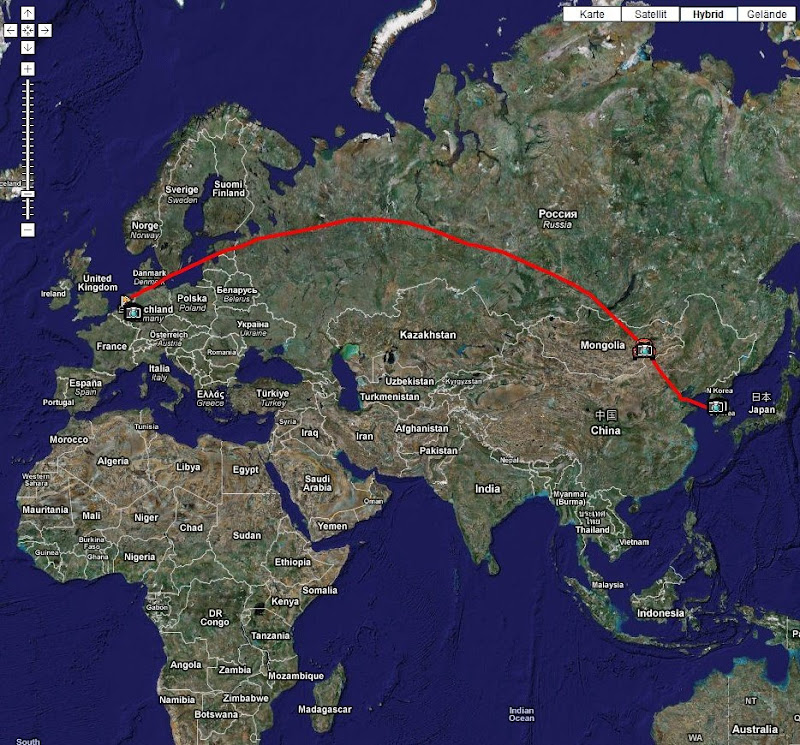
Which way did you fly to Korea?
We got a new USB GPS tracker(from Mobile Action, GT100) and had to try it out on the trip to Korea. It worked very well compared to the other devices we had so far. It got the bus trip in Düsseldorf airport right and the entire flight from Amsterdam to Seoul. Tracking worked well in the taxi from the Airport to the hotel. While walking in downtown Seoul it still performed OK (given the urban canyons) with some outliers.
Back in Korea, Adverts, Driving and Entertainment
On the way into town we got a really good price for the taxi (just make a mental note never to negotiate something with Florian and Alireza at the same time ;-) It seems taxi driving is sort of boring – he too watched television while driving (like the taxi driver some weeks ago in Amsterdam). I think we should seriously think more about entertainment for micro breaks because I still think it is for a good reason not allowed to watch TV while driving.
Seoul is an amazing place. There are many digital signs and electronic adverts. Walking back to the hotel I saw a large digital display on a rooftop (would guess about 10 meters by 6 meters). If working it is probably nice. But now it is mal functioning and the experience walking down the road is worsened as one inevitably looks at it. I wonder if in 10 years we will be used to broken large screen displays…
Sunday, 13 July 2008
Thermo-imaging camera at the border – useful for Context-Awareness?
When we re-entered South Korea I saw guard looking with an infrared camera at all arriving people. It was very hot outside so the heads were very red. My assumption is that this is used to spot people who have fever – however I could not verify this.Looking at the images created while people moved around I realized that for many tasks in activity recognition, home health care, and wellness this may be an interesting technology to use. For several tasks in context-awareness it seems straightforward to get this information from an infrared camera. In the computer vision domain it seems that there have several papers towards this problem over the recent years.
We could thing of an interesting project topic related to infrared activity recognition or interaction to be integrated in our new lab… There are probably some fairly cheep thermo-sensing cameras around to used in research – for home brew use you find hints on the internet, e.g. How to turn a digital camera into an IR cam – pretty similar to what we did with the web cams for our multi-touch table.
The photo is from http://en.wikipedia.org/wiki/Thermography
Saturday, 12 July 2008
ISUVR 2008, program day2
Norbert gave an interesting overview of research in the domain of ubicomp based on his personal experience – from Xerox PARC to the disappearing computer. He motivated the transition from Information Design to Experience Design. Throughout the work we see a trade-off between providing “smart support” to the user and “privacy” (or control over privacy). One of the questions if we will re-invent privacy or if it will become a commodity…As one of the concrete examples Norbert introduced the Hello.Wall done in the context Ambient Agoras [1]. This again brought up the discussion of public vs. private with regard to the patterns that are displays. (photos of some slides from Norbert's talk)
I gave a talk on “Human Interaction in Ubicomp -Magic beyond the screen” highlighting work in user interfaces beyond the screen that we did over the last years. It is motivated by the facts that classical limitations in computer science (e.g. frame rate, processing, storage) are getting less and less important to many application areas and that the human computer interaction becomes in many areas the critical part of the system.In my talk I suggested using “user illusion” as a design tool for user interfaces beyond the desktop. This involves two steps: 1) describe precisely the user illusion the application will create and the 2) Investigate what parameters have an influence on the quality of the created user illusion for the application. (photos of some slides from Albrecht's talk, Slides in PDF)
His talk focused on the domain of virtual reality with a focus on learning/training applications. One central thing I learned is that the timing of non-verbal cues (e.g. nodding) is very crucial to produce an engagement in speaking with an agent. This may also be interesting for other forms of computer created feedback.
Motivated by the vision that after the personal computer we will see the “Personal Robot” Daijin investigates natural ways to interact with robots. For vision based interaction with robots he named a set of difficulties, in particular: people are moving, robots are moving, and the illuminations and distances are variable. The proposed approach is to generate a pose, expression, and illumination specific active appearance model.Steven Feiner – AR for prototyping UIs
Steven showed some work mobile projector and mobile device interaction, were they used augmented reality for prototyping different interaction methods. He introduced Spot-light (position based interaction), orientation based interaction and widget-based interaction for an arm mounted projector. Using the synaptic touchpad and projection may also be an option for our car-ui related research. For interaction with a wrist device (e.g. a watch) he introduced the string-based interaction which is a simple but exciting idea. You pull out a string of a device and the distances as well as the direction are the resulting input parameters [2].In a further example Steven showed a project that supports field work on identification of plants using capture (of the image of the real leaf), comparison with the data base and matching out of a subset that matches the features. Their prototype was done on a tablet and he showed ideas how to improve this with AR; it is very clear that this may also an interesting application (for the general user) on the mobile phone.
[3] White, S., Lister, L., and Feiner, S.Visual Hints for Tangible Gestures in Augmented Reality.Proc. ISMAR 2007 IEEE and ACM Int. Symp. on Mixed and Augmented Reality, Nara Japan, November 13-16, 2007. (youtube video)
Finally some random things to remember:
- Richard W. DeVaul did some work on subliminal user interfaces - working towwrds the vision of zero attention UIs [4]
- Jacqueline Nadel (development psychologist) did studies on emotions between parents and infants using video conferencing
- V2 - Toward a Universal Remote Console Standard http://myurc.org/whitepaper.php
- iCat and Gaze [5]
[4] Richard W. DeVaul. The Memory Glasses: Wearable Computing for Just-in-Time Memory Support. PhD Thesis. MIT 2004. http://devaul.net/~rich/DeVaulDissertation.pdf
[5] Poel, M., Breemen, A.v., Nijholt, A., Heylen, D.K., & Meulemans, M. (2007). Gaze behavior, believability, likability and the iCat. Proceedings Sixth Workshop on Social Intelligence Design: CTIT Workshop Proceedings Series (pp. 109–124). http://www.vf.utwente.nl/~anijholt/artikelen/sid2007-1.pdf
Friday, 11 July 2008
ISUVR 2008, program day1
Thad Starner, new idea on BCIThad Starner gave a short history of his experience with wearable computing. He argued that common mobile keyboards (e.g. mini-querty, multi-tap, T9) are fundamentally not suited real mobile tasks. He showed the studies of typing with the twiddler – the data is impressive. He is arguing for cording keyboards and generally he suggests that “Typing while walking is easier than reading while walking“ . I buy the statement but I still think that the cognitive load created by the twiddler does not make it generally suited. He also showed a very practical idea of how errors on mini-keyboards can be reduced using text prediction [1] – that relates to the last exercise we did in the UIE class. (photos of some slides from Thad's talk)
He has suggested a very interesting approach to “speech recognition” using EEG. The basic idea is that people use sign language (either really moving their hands or just imagine to move their hands) and that the signals of the motor cortex are measured using a brain interface. This is so far the most convincing idea for a human computer brain interface idea that I have seen… I am really curious to see Thad’s results of the study! He also suggested an interesting idea for sensors – using a similar approach as in hair replacement technology (have no idea about this so far, but I probably should read up on this).
[1] Clawson, J., Lyons, K., Rudnick, A., Iannucci, R. A., and Starner, T. 2008. Automatic whiteout++: correcting mini-QWERTY typing errors using keypress timing. In Proceeding of the Twenty-Sixth Annual SIGCHI Conference on Human Factors in Computing Systems (Florence, Italy, April 05 - 10, 2008). CHI '08. ACM, New York, NY, 573-582. DOI= http://doi.acm.org/10.1145/1357054.1357147
Anind Dey – intelligible contextAnind provided an introduction to Context-Awareness. The characterized them as situationally appropriate applications that adapt to context and eventually increase the value to user. Throughout the talk he made a number of convincing cases that context has to be intelligible to the users, otherwise problems arise when the systems guess wrong (and they will get it wrong sometimes).
He showed an interesting example how data collected from a community of drivers (in this case cab drivers) is useful to predict the destination and the route. These examples are very interesting and show a great potential for learning and context prediction from community activity. I think sharing information beyond location may have many new applications.
In one study they use a windscreen project display (probably a HUD – have to follow up on this) We should find more about it as we look in such displays ourselves for one of the ongoing master projects. (photos of some slides from Aninds's talk)
Vincent Lepetit – object recognition is the key for trackingCurrently most work in computer vision used physical sensors or visual markers. The vision however is real clear – just do the tracking based on natural features. In his talk he gave an overview how close we are to this vision. He showed examples of markerless visual tracking based on natural features. One is a book – which really looks like a book with normal content and no markers – which has an animated overlay.
His take-away message was “object recognition is the key for tracking” and it is still difficult. (photos of some slides from Vincent's talk)
Jun Park - bridge the tangibility gapIn his talk he discussed the tangibility gap in design – in different stages of the design and the design evaluation it is important to feel the product. He argues that rapid prototyping, using 3D printing, is not well suited, especially as it is comparably slow and it is very difficult to render material properties. His approach alternative is augmented foam using a visually non-realistic but tangible foam mock-up combined with augmented reality techniques. Basically the CAD model is rendered on top of the foam.
The second part of the talk was concerned with e-commerce. The basic idea is that users can overlay a product into their own environment, to experience the size and how well it matches the place. (photos of some slides from Jun's talk)
Paper Session 1 & 2
For the paper sessions see the program and some photos from the slides.
photos of some slides from paper session 1
photos of some slides from paper session 2
Wednesday, 11 June 2008
Context-Aware adverts, google patent search
This evening I went to Münster to meet with Antonio Krüger and Lucia Terrenghi (who is now with Vodafone), who was visiting there. Advertisement is a hot topic and it was interesting that we shared an interesting observation “If the advert/information is the least boring thing to look at people will read it ;-)”. Each of us having their favorite anecdotal evidence: my favorites are people reading the same map everyday at their U-station and the advertising flyers in the Munich S-Train. For context-aware advertisement this is the major challenge to find the time/location where people are bored and happy to see an advert ;-)Thursday, 22 May 2008
Tutorial von Sensor to Context und Activity at Pervasive 2008
Abstract. Intelligent environments, sensor network and smart objects are inherently connected to building systems that sense phenomena in the real world and make the perceived information available to applications. In the first part of the tutorial an overview of sensors and sensor systems commonly used in pervasive computing application is given. Additionally to the sensor properties means for connecting sensors to systems (e.g. ADC, PWM, I2C, serial line) are explained. In the second part it is discussed how to create meaningful information in the application domain. Some basic features, calculated in the time and frequency domain, are introduced to provide basic means for processing and abstraction of raw sensor data. This part is complemented by a brief overview of mechanisms and methods for relating (abstracted) sensor information to context, activity and situations. Additionally general problems that are associated with sensing context and activity will be addressed in this tutorial.
Tuesday, 1 April 2008
Have Not Changed Profession – Hospitals are complex
This morning we had the great opportunity to observe and discuss workflows and work practice in the operating area in the Elisabeth hospital in Essen. It was amazing how much time from (really busy) personnel we got and this provided us with many new insights.The complexity of scheduling patients, operations, equipment and consumables in a very dynamic environment poses a great challenges and it was interesting to see how well it works with current technologies. However looking at the systems used and considering upcoming pervasive computing technologies a great potential for easing tasks and processes is apparent. Keeping tracking of things and people as well as well as documentation of actions are central areas that could benefit.
From a user interface perspective it is very clear that paper and phone communication play an important role, even in such high-tech environment. We should look a bit more into the Anoto Pen technology – perhaps this could be an enabler for some ideas we discussed. Several ideas that relate to implicit interaction and context awareness (already partly discussed in the context of a project in Munich [1]) re-surfaced. Similarly questions related to data access and search tools seem to play an interesting role. With all the need for documentation it is relevant to re-thing in what ways data is stored and when to analyses data (at storage time or at retrieval time).
One general message from such a visit is to appreciate people’s insight in these processes which clearly indicates that a user centered design process is the only suitable way to move innovation in such environments forward and create by this ownership and acceptance.
[1] A. Schmidt, F. Alt, D. Wilhelm, J. Niggemann, H. Feussner. Experimenting with ubiquitous computing technologies in productive environments. e & i Elektrotechnik und Informationstechnik, Springer Verlag. Volume 123, Number 4 / April, 2006. pages 135-139
Thursday, 31 January 2008
Reminded of the Ubicomp Vision
Michael Beigl made it more concrete and found coffee mugs (which were more than 20$ each) and attached a processor, communication and sensors. The MediaCup [2] showed several interesting results and underlined that such approach makes sense if there is an advantage.
[1] Schmidt, A., Aidoo, K. A., Takaluoma, A., Tuomela, U., Laerhoven, K. V., and Velde, W. V. 1999. Advanced Interaction in Context. In Proceedings of the 1st international Symposium on Handheld and Ubiquitous Computing (Karlsruhe, Germany, September 27 - 29, 1999). H. Gellersen, Ed. Lecture Notes In Computer Science, vol. 1707. Springer-Verlag, London, 89-101. DOI= http://dx.doi.org/10.1007/3-540-48157-5_10
[2] Gellersen, H. W., Schmidt, A., and Beigl, M. 2002. Multi-sensor context-awareness in mobile devices and smart artifacts. Mob. Netw. Appl. 7, 5 (Oct. 2002), 341-351. DOI= http://dx.doi.org/10.1023/A:1016587515822
Thursday, 27 September 2007
UbiLog Workshop in Bremen
Following the talk of Nikolai Krambrock we discussed the use context, and in particular location, to restrict or allow access to information. My favourite example is an online-banking appliance that only works in predefined areas (e.g. at home and in my car). Using context appears one option in creating human understandable solutions for secure systems. People have developed means to protect physical objects and valuable, perhaps we should draw more on this experience in the design of secure systems.
Wednesday, 12 September 2007
Article in the Economist
The article "The trouble with computers" appeared 6th of September and discusses a mix of ideas and viewpoints. We talked about 30 minutes on the phone and I am quite surprised what statement he picked from me (I said many things that were more interesting ;-). However I think it is great that people start trying to understanding the radical changes computers introduce - everywhere.
Tuesday, 4 September 2007
Automotive User Interface Workshop
At the German HCI conference (Mensch und Computer) I organized together with Paul Holleis and Klaus Bengler (BMW Group) a workshop on automotive user interfaces. We were surprised how many people work and research in this area in Germany and Austria.The 9 talks showed a wide range of research results and questions ranging from activity recognition, search interfaces, cultural issues to research methods. Dagmar Kern presented our work on a new method for interviewing drivers at the gas station. Stefan Graf from BMW groups had an interesting demo on object oriented interaction and in-car text input.
In the final session we discussed on future challenges of automotive user interfaces and it seems that it is a great challenge as cars are very emotional products. One interesting point was that user interfaces may not be central for the decisions which car to buy - but if not satisfied it will influence the decisions not to buy such a car again.Context and context-awareness (e.g. based on user activity, driving parameters and location) seems to provide a great opportunity for future interfaces and in-car applications. One nice example was presented by Susanne Boll from a joint project with VW (C3World, connected cars in a connected world).