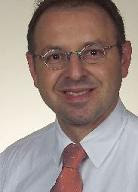
Prof. Hiroshi Ishii from the MIT Media Laboratory, kindly accepted our invitation to be the keynote speaker of TEI’08 in Bonn. We are absolutely delighted that he will come to the conference. Looking back at last year's proceedings of TEI, and seeing the references in the papers, it is obvious how much he has inspired and shaped this research field.
I recently learned that Prof. Ishii has lived and worked in Bonn in 1987-1988 at GMD (which became later Fraunhofer. He was then a Post-Doc and worked topics related to CSCW.
There are so many paper of tangibles media group one really has to read. If you have today little time watch this one: topodo.
Thursday, 29 November 2007


Talk at the opening of the Fraunhofer IAO interaction lab
The Fraunhofer institute IAO opened today a new interaction lab in Stuttgart under the topic interaction with all senses. Prof. Spath, director of the Fraunhofer IAO, made a strong argument for new user interfaces. In his talk he discussed adaptive cruse control in cars as an example for user interface challenges.
My talk on “implicit interaction – smart living in smart environments” argues for a sensible mix of user centred design and technology driven innovation. As one example I used the Sensor-Knife which Matthias Kranz implemented.
Prof. Jürgen Ziegler, a colleague at the University of Duisburg-Essen who was previously at IAO, showed in his talk a short video of a “galvanic vestibular stimulation” GVS explored by NTT (SIGGRAPH 2005 Demo) to highlight trends and indicate at the same time ethical problems that can arise when we interfere with human senses.
Tuesday, 27 November 2007
TEI’08 – in cooperation with ACM, inclusion in the digital library
TEI’08 will be held in cooperation with ACM and the proceedings will, as last year, included in the ACM digital library.
After finalizing the review and discussion process we have a really amazing program, which will be soon online at http://www.tei-conf.org/.
After finalizing the review and discussion process we have a really amazing program, which will be soon online at http://www.tei-conf.org/.
Visit at the University of Hamburg
Yesterday we visited the computer science department at the University of Hamburg. Prof. Oberquelle und Beckhaus had invited me at the Mensch & Computer conference to visit them and give a talk about our work.
Before the seminar we had a chance to see the lab of Steffi Beckhaus. I have tried the ChairIO – and it was fun. They sound floor creates a really interesting experience (similar to the butt-kicker just more intense). We could also play with GranulatSynthese and try the smell user interface (apple smell is absolutely convincing, not sure about some of the others).
We had some discussion on emotions and capturing physiological parameters. Thinking about emotions and senses with regard to a community sharing them opens up a lot of potential for new experiences and potentially applications. We discussed this topic to some extent some weeks ago at the Human Computer Confluence Workshop in Brussels. I really thing a small scale experience in share emotions could move us forward and provide some more insight. In Hamburg they have the NeXus-system (perhaps we should get this too and create a networked application).
In my talk (creating novel user interfaces) I focused on the PhD work of Paul Holleis (KLM for mobile phones, his CHI Paper from last year) and of Heiko Drewes (Eye-Gestures, his Interact’07 paper). The discussion was quite interesting.
Friday, 26 October 2007
Interesting MSc Dissertations at Trinity in Dublin
I have been at Trinity College in Dublin today as external member of the MSc exam board. While reading MSc dissertations I learned at lot of interesting things. Here are two pointers to technologies which I like to share (they may be useful in further projects):
SUMO - Simulation of Urban Mobility: An open source traffic simulation package
http://sumo.sourceforge.net/
Small computing platform: http://gumstix.com/
SUMO - Simulation of Urban Mobility: An open source traffic simulation package
http://sumo.sourceforge.net/
Small computing platform: http://gumstix.com/
Thursday, 25 October 2007
Slowly settling in
 Time is flying. We are nearly one month in Essen. Teaching started well and quite a number of students came to our course (see http://www.pervasive.wiwi.uni-due.de/en/teaching/). We have a reliable Internet connection and more furniture than we need ;-) Starting from scratch is a great experience – especially as everybody was very helpful.
Nevertheless it takes a lot of time and effort. I am extremly happy that I was able to start with a real team (Dagmar and Paul)!
Tuesday, 16 October 2007
In Search of Excellence
At the Fraunhofer retreat in Westerburg we had very interesting discussions on research and research strategies in computer science. The span of excellent research in computer science is enormous ranging from theoretical work (e.g. math style proofs), to engineering type work (e.g. systems), to experimental and empirical work (e.g. studies). This makes it really challenging to find a common notion of “excellent research”. This reminds me of an interesting book which I started to read (recommended to me at the retreat): In Search of Excellence: Lessons from Americas Best Run Companies by Robert H Waterman et al. – so far it is really interesting to read. However everything in management seems really straightforward on paper – but in my experience in the real world it always comes down to people.
Monday, 8 October 2007
Guest course at the University of Linz, MSc Pervasive Computing
 I am teaching a guest course at the
At dinner I learned why you can never have enough forks in a good restaurant. In case you loose your pen for the mobile phone a fork will do… The topic of the lecture is everywhere!
Information inside the cap
 Travelling on the train from Crailsheim to Nürnberg I saw several police officers on their travels back from an assignment at Stuttgarter Volksfest. When we got off the train the collected their caps from the luggage rack and observed an interesting (traditional) information display.
Inside the cap they carried a schedule and a description of the location they had to go. The size of the paper-display was about 15 x 15 cm. It seems an interesting place to display and access information – perhaps we will do a digital version of the cap as an assignment in our courses.
Wednesday, 3 October 2007
Starting from scratch – or how to bootstrap
At the moment our virtual presence (http://www.pervasive.wiwi.uni-due.de/en/) is much further than our physical – one has to have priorities.
Saturday, 29 September 2007
Moving to the University of Duisburg-Essen

From Monday on I will be at the University of Duisburg-Essen. After a little less than a year in Bonn a new challenge is ahead: setting up a new group on Pervasive Computing and User Interface Engineering.
 The focus will be on systems, user interfaces and novel applications in the domain of pervasive and ubiquitous computing.
The lab will be situated at the campus in Essen (Schützenbahn 70) in the heart of the city. Our group will be in the Institute for Computer Science and Business Information Systems in the faculty of Economics. Teaching starts in the winter term with a lecture on User Interface Engineering and several project oriented courses.
 The focus will be on systems, user interfaces and novel applications in the domain of pervasive and ubiquitous computing.
Thursday, 27 September 2007
UbiLog Workshop in Bremen
Following the talk of Nikolai Krambrock we discussed the use context, and in particular location, to restrict or allow access to information. My favourite example is an online-banking appliance that only works in predefined areas (e.g. at home and in my car). Using context appears one option in creating human understandable solutions for secure systems. People have developed means to protect physical objects and valuable, perhaps we should draw more on this experience in the design of secure systems.
Prof. Gerhard Krüger made honorary member of GI
At the dinner of this yeas GI conference Professor Gerhard Krüger became the 6th honorary member of the German Computer Science Society (GI, Gesellschaft für Informatik). He was one of the people who understood very early that computer science is a central topic and pushed in the 1980ies form higher capacities in computer science at German Universities.
When I was at
Thursday, 20 September 2007
Ubicomp 2007
We tried to explain the idea of ubiquitous computing to journalist and it seems they got the idea. And hence Ubicomp 2007 was featured in the Austrian Press:
- Mitdenkende Gegenstände - Allgegenwärtige Technik (ORF)
- Der Computer ist immer und überall (der Standard)
Ubicomp 2008 will be in Korea.
Monday, 17 September 2007
CardioViz Demo at Ubicomp 2007
Alireza Sahami presented our CardiViz project at the demo session at Ubicomp. We were very happy that the project that was the result of our IPEC course on developing mobile applications was accepted as a demo.
For more details see:
Alireza Sahami Shirazi, Diana Cheng, Oliver Kroell, Dagmar Kern, Albrecht Schmidt. CardioViz: Contextual Capture and Visualization for Long-term ECG Data. Adjunct Proceedings of Ubicomp 2007 (Demo).
Jonna Häkkilä, Anind Dey, Kari Hjelt, and I organized organized the Ubiwell workshop (Interaction with Ubiquitous Wellness and Healthcare Applications) at this years pervasive. Alireza presented another paper on heartbeat monitoring there:
Florian Alt, Alireza Sahami Shirazi, Albrecht Schmidt. Monitoring Heartbeat per Day to Motivate Increasing Physical Activity. UbiWell workshop@Ubicomp 2007.
Car UIs transport Emotion
 It is often discussed whether or not the user interface in the car matters or not. The basic argument is that cars are emotional and hence the driving experience matters and everything else is secondary.
However it seems the user interface becomes more and more part of the experience. On Saturday night I travelled via
The opening keynote at Ubicomp was given by Antonio Calvosa from Ferrari. Here two a very experienced and user interface focus could be seen. The talk touched issues of emotion and affective issues. Overall he argues that Ubicomp technologies should amplify what humans like to perceive.
Thursday, 13 September 2007
Our Papers at Interact 2007
Heiko Drewes, Albrecht Schmidt. Interacting with the Computer using Gaze Gestures. Proceedings of INTERACT 2007.
Richard’s paper is on collaboration support with a proxy based approach. Using our previous work on the UsaProxy we extended the functionality to supported synchronous communication while using the Web:
Richard Atterer, Albrecht Schmidt, and Monika Wnuk. A Proxy-Based Infrastructure for Web Application Sharing and Remote Collaboration on Web Pages. Proceedings of INTERACT 2007.
Wednesday, 12 September 2007
Article in the Economist
Some weeks ago Ben Sutherland from The Economist called. He was researching for an article discussing the computing revolution over the last 25 years. In his research he to talked to many different people (from different countries, different fields, different views) and was particularly interested in applications that will come in the future and with me in particular on the concept of context-awareness.
The article "The trouble with computers" appeared 6th of September and discusses a mix of ideas and viewpoints. We talked about 30 minutes on the phone and I am quite surprised what statement he picked from me (I said many things that were more interesting ;-). However I think it is great that people start trying to understanding the radical changes computers introduce - everywhere.
The article "The trouble with computers" appeared 6th of September and discusses a mix of ideas and viewpoints. We talked about 30 minutes on the phone and I am quite surprised what statement he picked from me (I said many things that were more interesting ;-). However I think it is great that people start trying to understanding the radical changes computers introduce - everywhere.
Monday, 10 September 2007
Mechanicals aids for addition and subtraction
 In the school museum I came across two very simple pen-based computing aids. The devices are very simple mechanical tools that help to do addition and subtraction. It was called ADDIATOR.
The utility is limited to addition and subtraction and it provides a very simple mechanism to deal with carry-over. If the number which is to be moved is white the calculation is without carry-over and one pulls it down. If the number is red then there will be a carry over one has to pull up and around the semi-circle (this is the mechanism for carry over). A carry over beyond the next position is displayed with a special sign and has to be resolved by moving the next position. The curator told me that he remembers people in shops used them and that people where very quick with them. It seems they have been popular till I was born.
Schools history, tangibles again

 After my daughter started school on Saturday we visited a historic school on Sunday. Comparing teaching materials is interesting. Especially providing up to date information in geography must haven quite a costly task. Many expensive charts and maps that were printed on canvas are now freely available in digital form. It seems that instead of having a film project, a slight projector, an overhead projector and canvas displays a computer and projector with internet access will do. Similarly having stamps to reproduce maps seems like ancient history, even though it has been still in use 20 years ago.
 However I wonder what we loose by make things digital and whether or not this matters. Having a database (a box with cardboard dividers and a lot of paper slips) or a typewriter (with types that are moved by pressing buttons) on your desktop gives you a very immediate impression how things work. It is remarkable to see that historically tangibility of teaching materials was very common.
 I think in the digital we should make more effort to provide means that people can understand the mechanism behind the technology (basics of HCI – conceptual models :-). This is however extremely difficult for purely digital products. My generation seems very lucky to have been witnesses of this transformation for many products from the physical to the digital – providing a lot of insight to us.

Wednesday, 5 September 2007
Our Papers at Mensch and Computer
The last 3 days we were at the German HCI conference (Mensch und Computer) in Weimar. Overall the conference had a really interesting program (21 papers with an acceptance rate of 30%), presentations from usability professionals and a number of workshops.
 Dagmar Kern presented our research on improving in-car telecommunication that was carried out together with people from BMW group in Munich. For details see:
Dagmar Kern, Albrecht Schmidt, Michael Pitz, Klaus Bengler. Status- und Kontextinformationen für die Telekommunikation im Auto. Mensch & Computer 2007. Weimar, September 2007.
 Heiko Drewes showed the initial results of the studies on eye-gestures for interaction. In this paper we proof that it is possible and sensible to use gesture with the eyes to interact with a computer. For more see the picture:
Heiko Drewes, Heinrich Hußmann, Albrecht Schmidt. Blickgesten als Fernbedienung. Mensch & Computer 2007. Weimar, September 2007.
Tuesday, 4 September 2007
Automotive User Interface Workshop
 At the German HCI conference (Mensch und Computer) I organized together with Paul Holleis and Klaus Bengler (BMW Group) a workshop on automotive user interfaces. We were surprised how many people work and research in this area in Germany and Austria.
The 9 talks showed a wide range of research results and questions ranging from activity recognition, search interfaces, cultural issues to research methods. Dagmar Kern presented our work on a new method for interviewing drivers at the gas station. Stefan Graf from BMW groups had an interesting demo on object oriented interaction and in-car text input.
 In the final session we discussed on future challenges of automotive user interfaces and it seems that it is a great challenge as cars are very emotional products. One interesting point was that user interfaces may not be central for the decisions which car to buy - but if not satisfied it will influence the decisions not to buy such a car again.
Context and context-awareness (e.g. based on user activity, driving parameters and location) seems to provide a great opportunity for future interfaces and in-car applications. One nice example was presented by Susanne Boll from a joint project with VW (C3World, connected cars in a connected world).
Monday, 3 September 2007
Watching movies on the train

 At the moment I am travelling a lot on the train and it seems that there is an increase in people using their mobile devices (e.g. Sony PSP, mobile phones) to watch cinema movies and episodes of TV-shows. Some individually and others even share the experience. Over the last years it become popular that people watched DVDs on their notebook computer on the train – but it seems the real mobile age is moving on.
Even though the screen is very small it shows again that one needs little to create the illusion of a movie. In the end it comes always back to the story…
Saturday, 1 September 2007
Cologne – New Pixel Window
 On Saturday on our way back home we made a stop in Cologne. After mounting the tower (509 steps) we had a look at the new window which lead to some discussion over the recent weeks.
It looks like pixels and is abstract in comparison to the other windows (which have traditional picture motives). To me it seems a neat idea that somehow reflects our time.
Wednesday, 29 August 2007
What do you decide in the car?
While waiting in Stuttgart
KIA has done a survey (with over 2000 people) in the UK on decision making in the car. It appears that people use the time in the car to discuss major issues in their lives and that they make significant decisions during long journeys. I have not found the original survey from KIA but there are several pages that discuss the results, e.g. gizmag.
 Some findings in short, people talked about/made descions: going on holiday (63%), buying a car (50%), moving (40%), getting a pet (26%), getting married (23%). The main reason for the car on a long journey being an effective environment for communication seems the fact the people are close together for a long time and no-one can walk away (41%). Also the fact that you have reason not to look the other person into the eyes, as you have to watch the street, was valued.
Thinking about it there it may also have to do with the function of space. A car puts people close together – in some case to intimate distances (up to 50cm) but defiantly to personal distances (50cm-125cm). There is a comprehensive overview by Nicolas Nova, Socio-cognitive functions of space in collaborative settings: a literature review about Space, Cognition and Collaboration (original reference to my knowledge is Hall, E.T. (1966). The Hidden Dimension: Man’s Use of Space in Public and Private. Garden City, N.Y.: Doubleday.).
This survey made me think more about the design space "car". Recently two of my students - Anneke Winter and Wolfgang Spießl - finished there master projects at BMW looking into search technologies and user interfaces in the car. It seems there are a lot of ideas that can be pushed forward realizing Ubicomp in the car.
Basics of Law - Talk by Herbert Burkert
 Herbert Burkert gave a presentation at
For developers and researchers in computer science that build real systems which can be deployed it is a great challenge to ensure compatibility with the law. In particular systems that are accessible over the world wide web in almost any country it appears really difficult to conform to all laws in the countries where potential users are.
It is clear that there is a distinction between morally right (or common sense right) and legally right - that is why many TV-pseudo-quiz programs are on and legal even though it is clear that common sense would see them as fraud. With new technologies there appears to be often a gap between on one side what is illegal and on the other side what is wrong but legal. The second one seems to be a domain where people make money...
Friday, 24 August 2007
Great tutorial on eXtreme Programming/Agile Methods
 Today Karl-Heinz Sylla and Reinhard Budde (both senior researcher at Fraunhofer IAIS) gave for the summer research project a tutorial on agile methods for software engineering. The experience they have from large scale real world projects is impressive! We looked at different approaches to software construction and discussed the pros and cons. Short iterations, user stories, pair programming and test driven development seem to fit very well to our work approach and project goals. A good starting point for more on the topic in particular with a teaching perspective are the following 2 papers:
 LeJeune, N. F. 2006. Teaching software engineering practices with Extreme Programming. J. Comput. Small Coll. 21, 3 (Feb. 2006), 107-117 and Schneider, J. and
From a user interface engineering perspective is very positive that agile methods are good to integrate with user centred design – in my experience much better than traditional software construction processes. Especially the fact that XP (eXtreme Programming) is open to change in functionally throughout the process is a key.
In this summer research project one great challenge is that the students have to build up knowledge in various areas (e.g. search technologies, web technology, user interfaces) while creating high quality code. There is a very interesting paper that discusses software engineering issues in the context of web applications: Jazayeri, M. 2007. Some Trends in Web Application Development. In 2007 Future of Software Engineering (
Always when the discussion comes to programming languages a debate on strong typing starts. Especially in the web context this seems come up again and again…
Thursday, 23 August 2007
Tico Ballagas defended his PhD in Aachen, New insight on Fitts' law.
 Today I finally got around visiting Jan Borchers (media computing group at
One part of Tico’s research was concerned with a definition of a design space for input devices. This is partly described in a paper in IEEE Pervasive magazine, see: Ballagas, R., Borchers, J., Rohs, M.,
Wednesday, 22 August 2007
Navigation by calories - New insights useful for next generation navigation systems?
In a German science news ticker I saw an article a inspiring post reporting an experiment on orientation in relation to food. It describes an experiment where men and women were asked to visit a set of market stalls to taste food and afterwards they are asked where the stall was.
The to me surprising result was that women performed better than men (which is to my knowledge not often the case in typical orientation experiments) and that independent of gender the amount of calories that are contained in the tasted food influenced the performance. Basically if there are more calories in the tasted food people could remember better where it was. I have had no change yet to read the original paper (Joshua New, Max M. Krasnow, Danielle Truxaw und Steven J.C. Gaulin. Spatial adaptations for plant foraging: women excel and calories count, August 2007, Royal society publishing, http://www.journals.royalsoc.ac.uk) and my assessment is only based on the post in the newsticker.
This makes me think about future navigation systems and in particular landmark based navigation. What landmarks are appropriate to use (e.g. places where you get rich food) and how much this is gender dependent (e.g. the route for men is explained by car-dealers and computer shops whereas for women by references to shoe shops – is this political correct?).
Apropos: landmark based navigation. There is an interesting short paper that was at last years UIST conference that looks into this issue in the context of personalized routes:
Patel, K., Chen, M. Y., Smith,
Perhaps this ideas could be useful for a future navigation system…
Tuesday, 21 August 2007
Meeting the inventor of the Petri-Net
 In the castle Birlinghoven on the Fraunhofer campus I had the privilege to meet Prof. Carl Adam Petri. He is a great mathematician and computer scientist who invented the Petri-Net. Today was a reception to celebrate that he received the “2007 Academic Gold Medal of Honor” from “the
Prof. Petri was from 1963 to 1968 head of the computing centre at the
 When I studied computer science I got introduced to the concept of Petri-nets but I never really thought about the person who invented it. It was only when I got the invitation to the reception that I really started thinking about the person and inventor and I was really impressed by the person. He got quite a few other awards before: Werner-von-Siemens-Ring, member of the Academia Europaea, Konrad-Zuse-Medaille etc..
Subscribe to:
Posts (Atom)